From the archive · compiled by Dick Cheeseman, January 1963
The Sennocke Cricket Club
1942–1963: A Short History
This is the full text of a recently rediscovered typed booklet from 1963, scanned and restored from a slightly damaged original. The statistics pages at the end are shown as images of the original typed pages — pinch to zoom on a phone. You can also download the booklet as a PDF.
Introduction
Twenty one years may seem a short life for Club, compared with many which date back a hundred years or so, but these years have been packed full of comradeship and enjoyment, and I am extremely pleased to have this opportunity of compiling a short history of our Club.
It has been possible to spotlight only a few of the players who, during the twenty one years, have represented Sennocke, and to those whose name appears only in the players career record section, I apologise for the omission.
For any errors, which I am afraid are bound to occur in a booklet of this nature, I apologise in advance, while if I have failed to mention any outstanding matches or feats, at least before 1953, one must remember that many of the playing records are missing.
I am most grateful to Mrs N.I. and Mr C.W.Berry, for all their help, and for allowing me the use of the Sennocke Social Club records. Also, to W.N.Bird, for help in various and many ways, and also to my family, for their friendly but constructive advice and criticisms.
For information concerning members who played for the Club prior 1951 I am especially grateful to W.N.Bird, H. and E. Crouch, and A. Boxall, while I must also thank D.E.Finch, T.Botten, and G.Marsh, for their help. All have shown exemplary patience in response to my cross examinations.
Apart from the box mentioned in the text, I have obtained much useful information from Frederick Lillywhite's "Cricket Scores and Biographies Vol 1, 1746-1825", while if you are interested in the chapter 'Knole', I strongly recommend the book "Knole", by V.Sackville—West.
D.C. January 1963.
The Club History
1942
The Sennocke Civil Defence Club was inaugurated during the Second World War, to provide recreation and amenities for the various personnel of the Civil Defence.
The first committee meeting was held in June 1942, to set up rules and regulations for the Club, who used the Ambulance Depot near the main post office at Sevenoaks, as their headquarters.
An 'occasional' cricket team was already being run by the Ambulance drivers, and D.E.Finch arranged a 'Possibles v Probables’ match, with the idea of selecting a team to represent the Sennocke Civil Defence Club. The game was played at Hollybush Recreation Ground on 7th July, the sides being made up of Club members and Ambulance drivers. The game proved a great success, and as a result a fixture was arranged with an Army Regimental team, stationed at Wildernesse.
Several other games were played in the '42 season, mainly against other Regimental sides, and although no records are available, it is said that we failed to win a match.
The officers of the Club in both 1942 and 3 were, Mrs Davis ('42), Mr A.Phillips J.P, ('43), presidents; and Messrs F.0,James, chairman; -. Cartwright, vice chairman; M.W.Tucker, secretary; and H.Lampkin, treasurer.
1943
By 1943, the Club boasted 130 members, and its activities in this and following years, included tennis, cricket, billiards, table tennis and other social evening games, whist drives, dances, garden parties, trips to shows and the coast, socials, lectures and debates. The Majestic Cinema (now the Odeon) was hired for a concert on one occasion, Richard ‘Mr Pastry' Hearne compering the show, while we were also largely responsible for organising the ‘Holidays At Home' open air dances on the Vine. Much work was done for charities, and indeed the proceeds of many functions went to worthwhile organisations.
A sports committee was set up in March, and A.T.Stevens (secretary) and D.E.Finch (captain), were elected as officers of the Cricket Section.
Unlike the First World War, club cricket continued throughout the Second, although activities were somewhat curtailed. However, games were played on nearly every Saturday from June to August, with a few evening games thrown in.
1944
1944 saw two firsts for the Cricket Section. Firstly, an independent Annual General Meeting, and secondly, the first cricket social evening, which was held in October.
In the former, A.T.Stevens (secretary); W.N.Bird (captain): and T.Marshall (vice captain), were elected.
Approximately 20 games were played, but unfortunately no records are available for the 1942 to 1945 seasons.
The following served the Social Section in 1944, Ccr. L. Drysdale, president; G.T.Bradbury, chairman; D.E.Finch, vice chairman; M.W.Tucker, secretary; and S.Cooper, treasurer.
1945
After the war, the Civil Defence disbanded, but members decided that the Club should continue to function, and in August, the St John's Ambulance Brigade Social Section amalgamated with us, under the name Sennocke Social Club. We moved to new headquarters at the Hospital Hut, and elected new officials. They were, G.T.Bradbury, president; D.E.Finch, chairman; A.Waters, vice chairman; E.Wigg, secretary; and F.J.Hopkins, treasurer.
The only change on the cricket side was a new vice captain in F.E.W. Crowson, and all were to be re elected again in 1946.
1946
This is the first season for which we have full records, and it proved to be highly successful. Of the 24 games played, 12 were won, and only 8 lost.
Perhaps our outstanding win was that against the Home Guard, when after scoring 137 for 7 dec., we dismissed them for a mere 15, while another good win was that against Kemsing, when facing our total of 98, they could muster only 21.
In our home game with Chelsfield, our batting completely collapsed, and could make only 43. However, our bowlers quickly hit back, and we eventually ran out winners by 13 runs.
The outstanding individual performance was without doubt the batting of D.Batchelor Snr., who in addition to scoring the first century for the Club, also became the first person to pass the 500 run mark in a season, his full record being 20 inns, 590 runs, average 34.7.
Second came D.E.Finch, 129 runs, av 11.72; then D.Batchelor Jnr., 202 runs, av 9.61; and F.E.W.Crowson, 165 runs, av 7.17s
E.Gifford topped the bowling, taking 19 wickets for an average of 6.52; and others worthy of recall are D.Batchelor Snr., 6; wkts, av 6.61; F.King, 1; wkts, av 7.53; and R.Hogg, 44 wkts, av 8.02:
1947
By 1947 the Club had arranged billiards, darts, and table tennis tournaments, in addition to the weekly Club night activities, socials and concerts etc., which were still held at regular intervals. There were now 54 members.
Officers in 1947 were G.T.Bradbury, president; D.E.Finch, chairman C.Hodge, vice chairman; Mr C.W. and Mrs N.I.Berry, secretaries; and F.J. Hopkins, treasurer.
At the A.G.M, at the end of the year, the Club elected their first Vice Presidents, namely, Sir John D.Laurie, Bart., J.P.; Major T.Hepburn, O.B.E.; S.V.Berwick, Esq.; A.Beveridge, Esq.; and W.M.Valon, Esq.; while the other officers elected for 1948 were the same as '47, with the exception of vice chairman and treasurer, W.N.Bird and l.J.Smythe being elected.
Unfortunately, there are no records of the '47 cricket season, although the minutes tell us that the secretary reported on "a very successful season", The side was led by D.E. Finch, with M.J.Smythe as the new secretary.
1948
1948 proved a poorer season, winning 12 and losing 16 of the 31 games played, and unfortunately, the weather was not too kind either, 7 games being rained off.
Two of the most remarkable games were our all day encounters with Etchinghill. In the first, they scored 202 for 2 dec. (I.Betts 96), and in reply we totalled only 38. In the return however, it was the turn of our batsmen to 'go to town', and we were eventually dismissed for 201 (D. Batchelor Snr. 73, D.Batchelor Jnr. 51). The Etchinghill batsmen offered stiff opposition, but thanks to J.Lock (5-36), were dismissed for 125.
Another good batting performance was put up against the Sevenoaks Vine 3rd XI, when D.Batchelor Jnr. (103 not) and W.N.Bird (19 not) enjoyed an undefeated partnership of 122, enabling us to declare at 155 for 2. We then dismissed the Vine for 146.
D.Batchelor Jnr. topped the batting averages with 461 runs, av 23,05; and he was followed by T.Simons, 301 runs, av 15.84; and F.Payne, 219 runs, av 15.64; Others worthy of note are W.N.Bird, 310 runs, av 12.91; A.Hdmunds, 101 runs, av 11.22; F.Meadows, 9; runs, av 10.33; and J.Lock, 195 runs, av 10.26; The bowling was topped by F.Meadows, 12 wkts, av 6.66; followed by H.Crouch, 39 wkts, av 6.71; J.Lock, 62 wkts, av 7.41; J.Garland, 18 wkts, av 8.44; and F.Payne, 17 wkts, av 9.47. The efforts of R.Hogg, are also worth noting, for although proving rather expensive (av 15.0), he nevertheless took 50 valuable wickets.
We had no ground of our own, and our home matches were played on the Hollybush Lane and Knole Paddock Council Grounds. It was therefore a serious business when the cost of hiring these was doubled, and after much discussion, an approach was made to Lord Sackville, to see if we could use his ground in Knole Park.
1949
Our approach to Lord Sackville was successful; and he kindly gave us permission to use the ground in Knole Park.
Before the war, this had been the ground of the Knole Estate side, but no games had been played there for many a year, and it had become terribly overgrown and covered with molehills. To add to this, it was littered with blockades, set up during the war to stop enemy aircraft from landing. Indeed, to say that much work was needed on it was a gross understatement.
However, members put in many hours of toil and sweat, and the ground was eventually ready for the start of the '49 season. Particular mention must be made of secretary M.J.Smythe, who practically lived for the Club during these early years, and apart from the enormous amount of work he put in, was also responsible for the loan of much Council equipment and machinery used in the repair of the ground.
Club President G.T.Bradbury, generously vacated his post, in order that Major General The Rt. Hon. Lord Sackville could succeed him.
Membership increased, and it was decided to run two sides on Saturdays. D.Batchelor Snr was elected captain of the Saturday 1st, Sunday and Evening XIs, while the duties of end XI skipper were shared by B.Barber and E.Crouch.
The Saturday 1st XI started in magnificent form, gaining wins of 102 for 4 dec. to 91 against Brasted and Sundridge, 197 for 9 dec. to 41 by Tonbridge Y.M.C.A., and 204 for 8 dec. to Halstead's 42. Then however, it was the turn of our opponents, and Otford beat us 170 to 35, Halstead 159 to 79, and the Vine 107 to 56. In all 14 games were played, of which 7 were won, 6 lost, and 1 drawn.
The Sunday and Evening XIs played 19, won 10, tied 2, drew 1 and lost 6. Their best wins included 162 for 4 dec. to 48 against Walter Smiths, 148 to 98 Petts Wood, and 101 for 7 dec. to 57 L.P.T.E.. The two tied games were against the Sevenoaks Dairy Farmers (52 each) and British Railways (48 each), while it was perhaps fitting that the games with Etchinghill, which had been won by such massive scores the previous year, were won and lost by only 12 and 5 runs respectively.
The Saturday 2nd XI won 6, drew 1, and lost 5.
1950
Before the 1950 season, we lost a number of our members to the forces and other local sides, and as a result only one team was fielded. However, under the leadership of skipper H.Crouch, the Club enjoyed their most successful season to date, 20 of the 36 games being won, as against 13 losses.
Our most comfortable wins were against Eltham Oddfellowes 160 to 35, British Railways 136 to 31, Polhill 176 to 74, and Sevenoaks Dairy Farmers 108 to 11.
The most enjoyable games were those with 'tight' finishes, and in particular the one run victory over Flower of Kent, and our two run defeat at the hands of Middle Row.
Despite our successes, we were on the receiving end on more than one occasion, and suffered heavy losses against Brasted and Sundridge 176 to 40 and 68, and Otford 126 to 39.
In October the Sennocke Social Club amalgamated with the newly revived Civil Defence, and moved to new headquarters at the Civil Defence Training Centre in Bradbourne Vale Road, under the name of the Sevenoaks Civil Defence Social Club. Officers elected were, president, Lord Sackville; chairman, D.H.Finch; vice chairman, W.N.Birds; secretaries, Mrs N.I. and Mr C.W.Berry; and treasurer, M.J.Smythe.
1951
Membership of the cricket section continued to decline, and at the A.G.M. it was decided to continue by a majority of only three votes, the new name of Sennocke Cricket Club being adopted.
Only ten members were available for more than ten games during the entire season, and this undoubtedly led to the decline in the quality of our cricket. We won only 9 games as against 14 losses, and the blame for this record must go to the batsmen, a fact which is emphasised in that on fourteen occasions we failed to reach a total of 70.
However, the cricket was most enjoyable, and our best wins were 160 for 5 dec. to 25 against Seal, 162 to 51 Sevenoaks Banks, and 114 for 5 dec. to 70 against Marley Tiles, while the drawn game with Petts Wood produced some whirlwind batting from G.Marsh (77 not) and J.West (66 not), who enjoyed an undefeated century partnership, and enabled us to declare at 192 for 3, Petts Wood made 147 for 7.
The two games with the Water Company proved the two closest of the season, both going in favour of the opponents, the scores being 51 to 53 and 94 to 97.
Our worst defeat was against Ashleigh Hurst, when facing their score of 102, we were dismissed for a mere 12.
P.Adams topped the batting averages with 127 runs, av 15.87; and others with respectable figures were C.Sayers 164 runs, av 11.71; H. Haffenden 165 runs, av 11.56; H.Crouch 132 runs, av 11.0; and N.MacCarthy 186 runs, av 10.33.
The bowling was headed by H.Crouch, who finished with 37 wkts, av 5.73; and then came N.MacCarthy 76 wkts, av 7.03; H.Haffenden 21 wkts, av 7.61; and G.Marsh 42 wkts, av 8.47.
1952
1952 saw several changes in the officials of the Club, M.J.Smythe taking over the captaincy of the cricket section from N.MacCarthy, while J.Watts became the new match secretary, succeeding L.T.Brown, who had served in this capacity for the last four years.
At the end of the year the Club suffered a severe loss when chairman D.H.Finch moved to Cambridge. He was succeeded as both chairman of the Social and Cricket Clubs by W.N.Bird. Dave, who was one of the founder members of the Club, had been chairman for seven years, and had also served as captain, vice chairman and vice secretary. He was presented with a Ronson lighter by Club members, in appreciation for all he had done.
Another presentation was that made to Mrs N.I.Berry, who had also worked unceasingly on our behalf. When the Social Club's activities were forced to come to an end in 1957, she had held the post of secretary for eleven successive years.
Members continued to work and improve the ground at Knole, and led by M.J.Smythe, water was laid on. Mick was also responsible for hiring a regular groundsman, Tom Botten. Tom worked at Knole, and before the Second World War played cricket for the Knole Estate Side. Indeed, he was their star bowler, taking over 100 wickets ten years in succession.
The blame for a not too successful season must go again to the batsmen, only D.E.Finch and J.Kenwood finishing with an average of above ten, and they played only seventeen innings between them. Fortunately, our bowlers were in the best of form, and enabled us to achieve better results than we perhaps deserved. Too often our opponents were dismissed for a moderate or small score, only for our batsmen to fail and throw the game away. For exemple, Oakland 40 to our 32, Sevengas 55 to our 50, Holmesdale 69 to 37, Decca Navigators 60 to 12, Green Street Green 62 to 36, and Hildenborough 65 to 44. Nevertheless, there were many enjoyable encounters in the record of 12 wins, 2 draws, and 16 losses.
J.Kenwood was the most successful batsman, his figures being 164 runs, av 14.90. He was followed by C.Howard 269 runs, av 9.60; H.Crouch 170 runs, av 9.44; and N.MacCarthy with 189 runs, av 7.57: D.E.Finch averaged 12.75, but played in only 5 games.
As has already been said, the bowlers were in splendid form, as can be judged from the following figures, H.Crouch 50 wkts, av 5.28; J. Sharp 32 wkts, av 5.59; H.Haffenden 20 wkts, av 5.85; G.Marsh 37 wkts, av 7.21; A.MacCarthy 28 wkts, av 8.50; and N.MacCarthy 5; wkts, av 8.77.
1953
1953 saw the introduction of several new members, and consequently a fuller fixture list was arranged by new secretary L.T. Brown.
Statistically, the season was little better than the previous one, the batting once again proving our downfall, although this was greatly stimulated by newcomers R.H.Cheeseman, A.Johnstone, and A,Ford. Altogether 45 games were played, 18 of which were won, and 21 lost.
In both the games with Etchinghill,we were defeated by an innings, 42 and 45 to 92; and 55 and 56 to 131; while other decisive losses were 61 to 172 by Holmesdale, 60 to 132 by Polhill, 72 to 148 by Hildenborough, 78 to 199 for 6 dec (R.Ayres 73) by Ide Hill, 25 to 129 for 7 dec by the Sev. & Ton. Water Co., and 13 (H.Dinham 8-8) to 70 for 7 by Otford (N.MacCarthy 6-37).
Our best wins were 171 (P.Delves 109) to 115 by R.E.Cheeseman's XI, 152 for 7 dec (R.E.Cheeseman 40) to 8; (R.E.Cheeseman 6-33) by Sevengas, 119 to 34 (G.Marsh 4-4) by Holmesdale, 106 to 18 (H.Crouch 6-6) by Sutton Y.C.,133 for 7 dec to 70 by Brasted and Sundridge, 107 for 3 dec (R.E. Cheeseman 46) to 103 (A.Ford 9-56) by Tunbridge Wells R.A.F.A., and 95 for 6 dec (R.E.Cheeseman 46 not) to 27 (N.MacCarthy 5-4, G.Marsh 5-18) by Suburbugas.
R.E.Cheeseman had a wonderful first year with the Club, scoring 425 runs in 27 innings, av 17.70. His nearest rival was C.Howard 314 runs, av 11 .62; and then came A.Johnstone 148 runs, av 11.38; A.Ford 185 runs, av 9.25; and L.T.Brown 297 runs, av 8.48:
The bowlers were led by J.Sharp 15 wkts, av 4.40; followed by G. Marsh 59 wkts, av 5.79; H.Crouch 50 wkts, av 6.28: A.Johnstone 24 wkts, av 7.50; A.Ford 33 wkts, av 8.66; and N.MacCarthy 51 wkts, av 9.09;
Other noteworthy achievements were the new Club wicket keeping record of 43 victims, set up by L.T.Brown, and the bowling of H.Best, who although averaging over 10.0, took 46 wickets.
1954
The 1954 season will long be remembered for the excellent fast bowling of H.Crouch and G.Marsh, who became the first bowlers to take 100 wickets in the Club's history.
For veteran Harry Crouch, his century was no ordinary feat, for it was the first time that he had ever gained 100 wickets in one season during his cricketing career, although he had been very near on a number of occasions, He was a very accurate bowler, and terribly fast in his younger days, indeed he represented the State of Sierra Leone in Africa, during the Second World War. His best returns included 8-22 against the British Railways, and 7-20 against Leigh.
For Geoff Marsh the achievement was particularly outstanding, for due to National Service, and the fact that he played regularly for his Regiment, he was not always able to play. Nevertheless, he made up for lost time when he did, his best returns being 9 wkts for 7 against L.P.T.B., 8-5 against Tunbridge Wells R.A.F.A., 7-7 against Polhill, and 6-12 against Brasted and Sundridge.
Both were presented with an inscribed cricket ball, to commemorate their achievements.
On a more dismal note, the batting was at its lowest ebb since the formation of the Club, and on 28 occasions the entire side was dismissed for less than 60, ten of these being for totals not reaching 40. Indeed, any side batting first and scoring over 60 runs had won the match before we batted, for our average for the entire season was only 50 an innings, and we only reached three figures on three occasions, 101 against Four Elms, 108 against the British Railways, and 128 for 7 against Dormansland.
Yes, the batting must certainly take the blame for the record of 14 wins and 10 draws as against 22 losses, and indeed this could have been much worse, for of the drawn games, 7 were moral victories for our opponents.
Despite our constant bad performances, our spirit had never been higher, and a fine example of this was B.Lock, who travelled from and to Surbiton, Surrey, every weekend, in order to play for us in preference to a local side. Unlike his brother Tony, the famous Surrey and England star, Brian batted left handed and bowled right.
Much credit for the fact that we remained in such good spirits must go to new secretary and skipper J.i.Johnston. During his association with the Club he never stopped toiling on its behalf, and all members are deeply indebted to him for the work he put in.
C.Howard was our leading batsman in 1954, his 327 runs averaging 18.16. Then came H.Crouch 278 runs, av 9.41; R.H.Cheeseman 340 runs, av 8.93; A.Ford 130 runs, av 6.84; and M.J.Smythe 188 runs, av 6.77; G.Marsh topped the bowling with 114 wkts, av 5.94; and then H. Crouch 10; wkts, av 6.46; who in turn was followed by A.Johnstone, 30 wkts, av 6.53; and J.O'Connell 5; wkts, av 7.96;
The season ended on rather an unhappy note, M.J.Smythe leaving the Club in order to live in Sandhurst (Berks). Mick had been secretary of the cricket section for six years, skipper for two, and also treasurer of the Social Club from 1948.
1955
The 1955 season produced only slightly better results, 18 wins, 24 losses, and 8 draws. The batting was our weakness yet again, and collapses were only too frequent.
H.Crouch had another wonderful year, taking 106 wickets, topping the batting averages, and making 1; catches. Both he and seventeen year old wicket keeper D,Cheeseman, were presented with awards. The former for his 100 wickets, and the latter for being the most improved player in the Club.
The most memorable match was undoubtedly the all day game at Dormansland, Surrey. The trouble all started at lunch time when our popular skipper and secretary Johnny Johnston said that he knew the way to the public house where lunch was to be served, and consequently we were not provided with a guide. All went well till we left the road to follow a narrow track, and eventually found ourselves facing Lingfield Racecourse. Abandoning the track, we set off through a wood, only to find our trail blocked by a barbed wire fence, and it did not help to find that the adjacent field was full of bulls and horses. Iuckily, we found a small gap in the barrier, and plucking up courage made our way through the field, finally finding ourselves facing a steep slope, at which several of us began running down to the bottom, where much to our dismay we found ourselves floundering ankle deep in a bog. However, in the distance we could make out some telegraph poles, so assuming it meant a road, we made our way towards them, only to find some railway tracks, and looking along them saw the bridge we had previously crossed.
When we eventually reached our destination, we discovered that a search party had been sent out for us, and they did not return till we had nearly finished our meal. Much later a very dishevelled and tired band of cricketers made their way back to the ground. The game was drawn.
H.Crouch topped the batting with 351 runs, av 10.96; second was C. Sayers 127 runs, av 10.58; and then came A.Ford 373 runs, av 10.36; and J. O'Connell 234 runs, av 9.36;
J.O'Connell was top of the bowling, with 77 wkts, av 6,88; and he was followed by G.Marsh 67 wkts, av 7.35; H.Crouch 106 wkts, av 7.53; RE.Cheeseman 46 wkts, av 8.71; and A.Ford 75 wkts, av 11.76.
In previous years we had been subsidised by the Sevenoaks Civil Defence Social Club, but now many of our members did not belong to this, and it was decided that from now on the Cricket Club should be responsible for its own expenses, and consequently a treasurer was added to our list of officers for 1956, A.Boxall being elected.
1956
The wet season of 1956 produced the best results for many years, indeed, we won more games than we lost, finishing with 23 wins, 4 draws, and 19 losses.
All seventeen members pulled their weight, whether with bat, ball, or in the field, but particular mention must be made of 54 year old H.Crouch, A.Ford, and R.E.Cheeseman, whose all round performances were outstanding, and cannot pass without mention.
Harry Crouch took over 100 wickets for the third time in succession, and his final tally of 131 is still a Club record. His best returns included 8-11 (Basted), 7-2 and 7-6 (Redland Sports), 6-11 (St John's), and 6-18 (Burnham Sports). He also scored 436 runs and took 17 catches.
Arthur Ford also took 100 wickets, and did the ‘hat trick’ on four occasions. His subtle spinners often mesmerised our opponents, his best figures being 8-23 and 6-18 (Conniston), 6-12 (Sev. & Ton. Water Co.), 5-14 (St John's), 5-16 (New Kent), and 5-18 (Halstead). In addition, he scored 427 runs and made 9 catches.
Reg Cheeseman's figures of 360 runs, 55 wickets, 9 catches, are all the more creditable when one recalls that in the first game of the season against Leigh, he had a recurrence of an old cartilage injury and was forced to retire hurt for 42. This resulted in him missing the next twelve games, and for much of this time he was forced to use crutches.
Both Harry and Arthur were presented with the accustomed inscribed cricket ball, while the former also won the cup for the most improved player, presented by the skipper J.R.Johnston, who incidentally had set up a Club record himself, by taking 21 catches.
A third record was set up this year, D.Cheeseman taking 60 victims behind the stumps, and letting through only 58 byes in 52 innings.
No colossal scores were made by either side, although we did have our share of three figured totals, but we were still apt to collapse too frequently, as indeed against Leigh, Knockers and Chevening, who we had dismissed for 47, 60 and 76 respectively. In reply we could muster only 20, 27 and 35.
The performance of the season was easily that against Buckhurst, when after scoring 80, we dismissed them for 15, and putting them in again, promptly whipped them out for only 10.
Newcomer G.L.Bennett added much solidarity to our batting, and finished top of the averages with 211 runs, av 13.18; and he was followed by the three already mentioned, H.Crouch 436 runs, av 12.825 R.E.Cheeseman 360. runs, av 12.41; and A.Ford 427 runs, av 11.86;
The bowling was topped by H.Crouch with 131 wkts, av 4.51; and then R.Waghorn 18 wkts, av 4.97; G.Marsh 62 wkts, av 7.24; R.E.Cheeseman 55 wkts, av 7.78; A.Ford 100 wkts, av 7.80; and A.Boxall 36 wkts, av 8.38;
1957
R.E.Cheeseman was elected skipper in 1957, and he led the team to their most successful year so far, 2; games being won, 5 drawn, 1 tied, and 15 lost.
The tied game was that against Conniston, when, after losing 3 wickets for 9 runs, we rallied, and thanks to H.Crouch (46), we totalled 119. Then, after a useful start, Conniston collapsed and lost 4 wickets for 6 runs. However, they too rallied, and when their last man took the crease their score stood at 102. The runs mounted slowly, till, with the scores level, their last man was clean bowled.
Another exciting match was that with Halstead, when, facing our total of 127 their score stood at 93 for 8 with only one over to go. Tension mounted as H.Crouch strode up to bowl; the first three balls were all played, but he broke through and took wickets with his fourth and sixth ball, to give us victory on the last ball of the match.
Two other extraordinary games were those with Dormansland and Basted. In the former, A.Ford (93) and R.Duffin (50) enjoyed a partnership of 121, and at one stage the score stood at 140 for 3. Then however, there was a dramatic collapse, and the whole side was dismissed for 158, 2 being the third highest score and seven batsmen getting ducks. There were 12 extras.
In the game with Basted, we lost 8 wickets for only 9 runs, and all seemed lost, but thanks to the efforts of R.E.Cheeseman (22 not), we managed to scramble 38. Our opponents had hardly recovered from their gleeful boasting before they were shot out for only 22, D.Daniel taking 7 for 11.
A.Ford had yet another outstanding season with both bat and ball, becoming the first batsman to score over 500 runs since 1946. He also took 117 wickets and 11 catches. His best bowling returns were 6-4 (Hildenborough) 5-7 (Ide Hill), 5-10 (Sev. & Ton. Water Co), 5-11 (Leigh), 6-21 (Redland Sports), 5-19 (Rusthall), and 6-24 (Tun. Wells Y.HM.C.A.), while his knocks included 93 (Dormansland), 70 (Ide Hill), and 63 not (International Paints).
G.Pinhorn topped the final batting averages with 210 runs, av 26.25; followed by R.Duffin 315 runs, av 16.57; G.l.Bennett 280 runs, av 14.73; A.Ford 55; runs, av 13.16; R.E.Cheeseman 426 runs, av 11.51; H.Crouch 404 runs, av 10.63; and D.Cheeseman 534 runs, av 10.26;
D.Daniel was the top bowler with 45 wickets, av 6.20; then came G. L.Bennett 18 wkts, av 6.44; H.Crouch 77 wkts, av 7.0; R.Duffin 50 wkts, av 7.32; A.Ford 117 wkts, av 7.67; G.Marsh 4; wkts, av 8.40; while A.Boxall also merits mention, 51 wkts, av 10.33;
During the year difficulties arose between the new Civil Defence leaders and the Social Club, and eventually, after much discussion, the latter was disbanded, leaving their money assets to our Club. Not enough can be said in praise and thanks to the Social Club, for apart from the money, they had always helped us in any capacity they could, and their officers in particular had put in much work on our behalf. Without their help and financial aid during our earlier years, we would never have survived. Their last existing and paid up members were Mrs N.I.berry, and Messrs C.W.Berry, N.R Hutchings, W.N.Bird, L.C.Purday, H.Crouch, J. Piper, A.Ford, and A.Boxall, and all are eligible to become members of our Club.
1958
In February, at a special meeting, the rules of the Social Club were rescinded, and a new set adopted for the Cricket Club, while another pre season occurrence was the retirement of our groundsman Tom Botten. It was decided that in future Club members should look after and prepare the pitch each week.
R.L. Bassett was newly appointed secretary, while other officers were W.N.Bird, chairmang R.E.Cheeseman, captains A.Boxall, treasurer and vice captains and L.J.legood, match secretarys.
1958 was one of the wettest seasons for many a year, and seven games were washed out. Of the 44 played, 21 were won, and 17 lost.
Our closest encounter was undoubtedly the all day game with New Kent. We dismissed them for only 38 (A.Boxall 6-17), and then made 82 ourselves, In their second knock, they made 77 (A.Ford 6-10), which left us just 34 needed to win. We settled back to watch our openers knock off the runs, always a fatal thing to do, and this proved no exception. We lost 4 wickets for 19 runs, 6 for 27, and then 9 for 31, with our number 11 at the crease. Tension mounted to boiling point as he played at and missed the first four balls, but then a snick through the slips and we had won.
Actually the season produced comparatively few close finishes, and most games were decided by a fairly large margin. We beat Redland Sports by ten wickets, Royal Opera House Covent Garden and St John's by eight wickets, and Woolwich M.N.I. by 118 runs, while the Amblers beat us by ten wickcts, Ide Hill by nine, and Stowting by 93 runs.
Another heavy defeat was inflicted by H.J.F.Crum Ewing's XI, and their side included W.H.Payne the Oxford University batsman, who scored 99 of his sides total of 165. Their side also included Minor Counties fast bowler R.P.Lewis, who was mainly responsible for-our score of only 70, his figures being 9 overs, 7 maidens, 5 wickets, 3 runs.
Our home game with North End and Felbridge is also worthy of mention, for it produced both our highest individual score, and fastest scoring rate during the season. J.Bassett was the batsman, and his whirlwind 52 in twenty minutes, including five sixes, enabled us to put on 128 in just fifty five minutes. However, despite this we lost by 33 runs.
The outstanding individual performance was without doubt the superb bowling of G.Marsh in the all day game with Sandhurst (Berks). He took 8 for 22 in the first, and 9 for 12 in the second innings, to give us victory by six wickets. His match analysis is worth a line of its owns— 22 overs, 13 maidens, 17 wickets, 34 runs, 2.0 average.
G.L.Bennett topped the batting with 282 runs, av 14,10; then came R.Duffin 264 runs, av 13.69; G.Pinhorn 149 runs, av 13.54; C.Warren 525 runs, av 11.93; R.E.Cheeseman 462 runs, av 11.84; A.Ford 183 runs, av 11.75; and D.Chceseman 484 runs, av 10.08; The bowling was led by R.J.Lane 35 wkts, av 6.80; followed by H. Crouch 41 wkts, av 7.07; G.Marsh 72 wkts, av 7.11; G.L.Bennett 24 wkts, av 7.25; A.Ford 50 wkts, av 8.0; R.Duffin 35 wkts, av 9.0; R.E.Cheesman 45 wkts, av 11.33; and A.Boxall 63 wkts, av 11.92:
1959
In contrast to the previous year, 1959 proved the hottest and driest in living memory for many people, and the cricket often equalled its splendour, with many tight finishes and plenty of runs.
Closest of all was the game with the Amblers, when facing a total of only 56 (R.E.Cheeseman 7-17), we reached the same score for only 7 wickets. However, our tail failed to wag - even to the extent of 1 run, and the game was tied.
The matches with Brasted and Sundridge, Redland Sports and Hildenborough were almost as close, ths scores being 83 to 82 against us, 42 to 43 in our favour, and a draw 99 to their 91 for 9. Our batting had been improving by leaps and bounds during the last few years, and the glorious weather seemed to inspire us to even greater heights, indeed D.Cheeseman scored 943 runs, and so set a new Club record.
The most decisive win was that against Sev. & Ton. Water Co. when, after scoring 166 for 6 dec (D.Cheeseman 51, A.Ford 51), we dismissed them in just 6.4 overs, for 16, G.Marsh taking 8 wickets for 4 runs.
Other decisive wins were 137 (D.Cheeseman 66) against Tunbridge Wells R.A.F.A. 23 (G.Marsh 6-11), 167 (R.J.Lane 50) to 55 (G.L.Bennett 5-14) by the Royal Opera House, 173 for 4 dec (D.Cheeseman 58) to 74 by Buckhurst, and 180 (D.Cheeseman 46) to 90 (G.Marsh 5-24) by St John's.
The bowlers were not to be left out of the merry making, (as can be seen from the above figures), and G.Marsh and A.Boxall took full advantage of the hard wickets, and performed splendidly in taking 108 and 109 wickets respectively. Geoff's best figures included 8-4 (Sev. & Ton. Water Co.), 6-11 (Redland Sports), 6-11 (Tun. Wells R.A.F.A.), 6-21 (Lamorbey), and 5-16 (Sev. & Ton. Water Co.), while Alan's were 7-21 (Amblers), 6-15 (Halstead), 6-16 (Basted), 5-15 and 5-16 (Redland Sports). Both were presented with an inscribed cricket ball to commemorate their performances.
One of the most memorable innings in a season which produced 30 wins as against 16 losses, was L.Gardner's hurricane 54 in fifteen minutes against Sandhurst. His knock consisted of four sixes, six fours, two twos, and just two singles.
D.Cheeseman finished top of the batting averages with 943 runs, av 18.49; and he was followed by G.Pinhorn 130 runs, av 16.25; A.Ford 259 runs, av 16.19; R.Duffin 29; runs, av 15.68; G.L.Bennett 182 runs, av 13.0; R.E. Cheeseman 480 runs, av 12.30; S.Field 144 runs, av 12.0; R.J.Lane 255 runs, av 11.59; and C.Warren 267 runs, av 10.68:
Ten bowlers finished with an average below 10.0, including G.L. Bennett 27 wkts, av 4.33; G.Marsh 103 wkts, av 6.46; H.Crouch 26 wkts, av 6.61; R. Duffin 55 wkts, av 7.33; R.E.Cheeseman 78 wkts, av 7.65; A.Boxall 109 wkts, av 7.70; P.E.Colwill 26 wkts, av 8.34; and A.Ford 35 wkts, av 8.48:
Unfortunately, the season was marred by the prolonged absence of A. Ford, who was suffering with a back injury for the second consecutive year. Fortunately, he managed to play several games at the beginning and end of the season. Another blow was the unfortunate accident to our chairman W.N.Bird, which finished his playing career. However, he became our umpire, a post which he still holds today.
1960
In 1960 we returned to our normal summer weather - wet, but this could not dampen our enthusiasm, and the Club enjoyed its most successful season yet, winning 29 and losing only 13 of the 46 games played.
No doubt aided by the new Indoor Cricket School which had been erected for winter practice in Sevenoaks, the batsmen revelled. Particular mention must be made of G.Pinhorn, for he made five fifties, and never once failed to reach double figures. His innings were a delight to watch, and for the record, his scores were 14, 38, 62, 31not, 59, 84not, 10, 57not, 18 and 51.
Runs flowed freely and many large scores were amassed by one side or the other. 210 for 5 dec (G.Pinhorn 84not, R.J.Lane 47) to 50 by Westerham, 205 for 7 dec (A.Ford 73) to 70 (R.J.Lane 4-11) by Sevenoaks School, 189 (A.Ford 50) to 158 by Sev. & Ton. Water Co., 172 (D.Cheeseman 55) to 90 (P.H.Colwill 5-31) by H.J.F.Crum Ewing's XI, 164 for 7 dec (P.E.Colwill 59not) to 104 (G.Marsh 5-32) by Woolwich M.N.I., 43 and 105 for 5 (D. Cheeseman 52not) to 211 (V.Honour 82, K.Nelson 70) by North End and Felbridge, 96 for 7 to 196 for 6 dec (Vizard 103) by Tonbridge Ramblers, 90 to 164 (J.Smith 78not) by Ide Hill, 144 for 7 dec to 56 (G.Marsh 5-13) by Carlton Sports, 127 for 9 dec (D.Checseman 49not) to 12; for 6 (B.Batchelor 78) by Leigh, 12; for 8 (G.Pinhorn 59) to 119 (D.Checseman 7-48) by the Amblers, and 122 to 126 for 6 by New Kent.
Despite all those runs (there were another six innings of over 120), three of the most enjoyable games failed to produce a score of three figures amongst them.
In our away game with Tunbridge Wells Y.M.C.A. we were dismissed for a mere 45, but thanks to some magnificent bowling and fielding, sent the Y.M.C.A. back for 35, A Boxall taking 5-23.
The home game with Basted was even tighter, and after dismissing them for 49 (A.Ford 6-33, A.Boxall 4-15), we lost 9 wickets for 46. Our last pair hung on for several overs till finally a bye gave us victory.
Our first game with the Ex Blues was equally as exciting, although it seemed all over when they had reached 76 for 4, after dismissing us for only 87. However, there was an amazing collapse, till they were 64 for 9. Their last two batsmen then managed to score the four runs needed for victory.
G.Pinhorn easily headed the batting averages with 424 runs, av 60.57; while others who warrant praise were D.Cheeseman 902 runs, av 20.04; A.Ford 453 runs, av 15.62; P.E.Colwill 234 runs, av 13.0; R.Duffin 206 runs, av 12.87; R.E.Cheeseman 547 runs, av 11.63; A.T.Bake 145 runs, av 11.15; R.J.Lane 277 runs, av 11,08; and L.Gardner 140 runs, av 10.76.
R.Duffin headed the bowling with 41 wkts, av 7.73; then came G. Marsh with 73 wkts, av 8.52; H.Crouch 30 wkts, av 9,86; R.E.Cheeseman 72 wkts, av 9.30; A.Ford 69 wkts, av 9.66; R.J.Lane 36 wkts, av 9.75; and A. Boxall 53 wkts, av 11.17;
1961
The honours for 1961 went again to the batsmen. They scored over 5,000 runs, averaged over 100 an innings, and indeed, the whole side was dismissed in only half of their innings.
The success of the openers was outstanding, and between them, D. Cheeseman, G.P.Griffiths and R.E.Cheesceman had cight partnerships of over 50, another eleven over 30, and on thirty three occasions they reached double figures before being parted.
D.Cheeseman merits special mention, for in scoring 1185 runs, he set a new Club record, and became the first player in its history to reach the coveted 1000. His consistancy was such, that in 23 consecutive innings he failed to reach double figures only once. His scores included 59 not (Royal Opera House), 59 not (Leigh), 5; (North End & Felbridge), 56 not (Four Blms), and 54 (Hildenborough). The bowling in general scemed to have lost some of its 'bite', but R.H.Cheeseman and G.Marsh bowled particularly well, the former taking 104 wickets. His best figures were 7-23 and 5-10 (Westerham), 6-11 (Sev. & Ton. Water Co.), and 5-19 (Hildenborough).
Room must be found for mention of fifteen year old I.Franks, who improved out of all recognition. He scored nearly 500 runs, took 34 wickets, made 19 catches, and was selected for special winter coaching by Kent cricketers Colin Page and Ray Dovey for the second successive year.
In all 24 games were won, 11 drawn, and 11 lost, and of these the most memorable were our away game with North End and Felbridgo (who we beat by 100 runs), and our annual game with H.J.F.Crum Ewing's XI. In the latter our visitors won the toss, and electing to bat were soon lashing our bowling to all parts of the ground, and in only 110 minutes had amassed the enormous total of 279. The 'tormenter in chief' was J.Grey who played for the Royal Engineers and Army, and he scored 116, including 26 off one over. He was ably supported by Oxford graduate R.Gilks, who made 73. I.Franks bowled extremely well finishing with 5-46. In reply we could muster only 90, and this was largely due to the efforts of D.Cheeseman who scored 44.
The batting averages wore topped by D.Cheeseman with 1182 runs, av 26.26; who was followed by A.Ford 279 runs, av 17.43; I.Franks 492 runs, av 14.90; R.E.Cheeseman 618 runs, av 14.37; G.P.Griffiths 269 runs, av 13.45; R.J. Lane 33; runs, av 12.33; S.Field 86 runs, av 12.28; G.Pinhorn 97 runs, av 12.12; and G.Marsh 210 runs, av 11.66;
The bowling was headed by 59 year old veteran H.Crouch with 13 wkts, av 4.84; then came G. Marsh 89 wkts, av 8.52; R.E.Cheeseman 104 wkts, av 9.99; and R.J.Lane 43 wkts, av 11.81; Others worthy of mention are A. Boxall 85 wkts, av 12.71; and I.Franks 34 wkts, av 11.89:
In November we held our first Dinner since the days of the Social Club, and it was attended by 58 members and guests, the guest speakers being K.R Nelson and H.J.F.Crum Ewing. During the cvening presentations were made to both R.E. and D.Checseman, for their performances with bat and ball.
All officers were re electcd for the 1962 campaign, that is Lord Sackville, president; W.N.Bird, chairman; D.Cheeseman, secretary; R.L. Bassett, asst. secretary; A.Boxall, treasurer.; R.E.Cheeseman, captains and R.J.Lane, vice captains.
1962
1962 was another outstanding year for the Club, although it was marred by the death of our President, Major General The Rt. Hon. Lord Sackville, K.B.E., C.B., C.M.G.. His kindness and generosity will always be remembered by our Club,
We are most fortunate in having his nephew, L.Sackville-West, to succeed him.
The season produced 25 wins, 13 draws, and 14 losses, and the honours went undoubtedly to the batsmen. Both I.Franks and D.Cheeseman scored well over 1000 runs, while R.E. Cheeseman nearly made it a threesome, falling only 10 short of the coveted number.
16 year old I.Franks was outstanding, and played many brilliant knocks. He scored two centuries, 131 and 114 not, and four fifties, 93 not, 55 and 51.
D.Cheeseman's best knocks included 108 not, 84 not, 54, 52 and 51 not, while R.E.Cheeseman made scores of 96 not, 78, 72, 52, and 50.
Our batsmen amassed nearly 6500 runs, averaged over 120 an innings, and hit three centuries and twenty individuel fifties. Runs flowed freely and many high totals were recorded. These included—
224 (I.Franks 131) v Sandhurst 88 (G.Marsh 8-31)
202-6dec (B.Scragg 56 not, I.Franks 55) v Seal 105-8
201-7dec (S Field 61) v Rusthall 95 (R.Cheeseman7-39)
193-5dec (R.Cheeseman 96 not, D.Cheeseman 52) v Woolwich MNI 37 (P.Colwill 6-9)
190-2dec (I.Franks 93 not) v Round Table 76
182-4dec (I.Franks 72 not, R.Cheeseman 50) v Rusthall 53 (A, Boxall 5-25)
178-2dec (D.Cheeseman 108 not) v Tun Wells RAFA 160
178 (G.Pinhorn 58 in 19 minutes) v Westerham 133
176-4 (I.Franks 114 not) v H.Crum Ewing's XI 229-6dec
172-7dec (G Pinhorn 59) v Woolwich MNI 55 (R.Cheeseman 5-13)
160-9 (C.Burchell 36) v Crockham Hill 163
159-4dec (D.Cheeseman 84 not) v Ide Hill 161-4
155-8dec (RE Cheeseman 72) v D.Cheesemans X1 88 (D.Cheeseman 51)
There were also another six totals of over 130, and another thirteen over 100,
I.Franks topped the batting averages with 1213 runs, av 31.92; then followed D,Cheeseman 1132 runs, av 25.72; R.E.Cheeseman 990 runs, av 19.80; R.J.Lane 369 runs, av 19,36; G.Pinhorn 170 runs, av 18,88; S.Field 163 runs, av 18,11; R.Howgill 97 runs, av 16,16; B.Scragg 322 runs, av 15.33; G.P. Griffiths 229 runs, av 11.45; D.Tarr 144 runs, av 11.07; P.E. Colwill 245. runs, av 10.20; and A.Boxall 141 runs, av 10.07: A.Ford scored 141 runs in only 4 innings, but unfortunately was then injured, and forced to miss the rest of the season.
R.J.Lane headed the bowling with 51 wkts, av 8.13; then came I.Franks 87 wkts, av 9.11; R.E,Chedseman 75 wkts, av 9,84; G.Marsh 60 wkts, av 9.91; I.Fordham 37 wkts, av 11.16; P.H.Colwill 65 wkts, av 13.16; and A.Boxall 37 wkts, av 15,43;
One of the most pleasing aspects of 1962 was the introduction of Several new members, particularly youngsters, and as a result several 'B XI’ games were arranged. 6 games were played, and although only 1 was won, it was most encouraging. A Saturday B XI will be run in 1963, and better things are expected, The Club now has 30 playing members, 20 non playing, and a balance of over £100.
On Reflection
So we come to the end of our first twenty one seasons, and look forward to the next, wondering what the future holds in store for us. One thing is certain, we can face it confidently, for the name Sennocke now ranks high amongst other Clubs, and even if we fall short of the playing standards of a few Clubs, our spirit and comradeship is unsurpassed.
In an age when fall off in membership is commonplace, we are fortunate in having a number of promising youngsters, and we are confident that win or lose, they will live up to the standards which have become associated with our name, and we hope that they will help take our Club to even greater heights.
We are proud, and I think justly so, of the many youngsters who have passed through our Club. J.0'Connell and D. Daniel immediately spring to mind, both having played for the Vine 1st, while R.G.Dickenson who now plays for Holmesdale 1st XI, has also represented the Sevenoaks A.K.C.C. side. Only this year I.Franks played for the Kent Club and Ground, and in other representative games. We have been represented in the Sevenoaks District A.K.C.C. Junior teams by J.0'Connell, D.Daniel, C.Warren, and I.Franks, while I.Fordham has joined the latter in being selected for special winter coaching by Kent cricketers Colin Page and Ray Dovey.
The sterling work put in on the ground at Knole is now beginning to pay dividends, and we can offer visitors not only one of the most picturesque grounds in the country, but also one of the truest wickets in the district, and I know we intend to improve it even more.
In this booklet, our opponents have received only casual mention, often when notable feat has been performed against them by some Sennocke team or player, but it would not be right to close without paying tribute to them all, and thanking them for the many enjoyable encounters, and time spent in cach others company. As a matter of interest, here is a list showing the sides we have played most (1946-1962).
Brasted and Sundridge 39
Tunbridge Wells R.A.F.A. 24
Sev. & Ton. Water Co. 32
Four Elms 21
Ide Hill 30
Otford 20
Halstead 28
St Johns 20
Hildenborough 26
Walter Smiths/Amblers 16
In January 1963, we shall be celebrating our twenty first birthday by holding a Dinner-Dance. In addition to Sennocke members, those present will include ex members, and representatives from other Clubs. Guest speakers will be founder member D.E.Finch, and R.R.Dovey, Kent C.C.C., while other guests will include J.C.T.Page, Kent C.C.C., and H.W.Giles, Chairman of the Sevenoaks District Association of Kent Cricket Clubs.
One last word before closing, a belated, but thoroughly deserved word of praise and thanks to ‘our ladies', for their continued help and support over the years, and in particular to Mrs M.Boxall, who rarely misses a match, home or away, and who has provided us with such excellent teas during the past seven years; thank you all.
Knole and Cricket
Historians have it that Knole was a residence as far back as King John's reign (1199-1216), but the first known reference to Knole appears in the Lambeth Palace papers of 1281, at the time of Edward 1st.
After having been in the possession of a number of different owners , it passed on to Geoffrey, Lord de Say, in approximately 1370, and on his death to his son, who in turn left it to his three sisters. Later, James Fiennes, son of one of these ladies, took possession, and he sold it to Thomas Bourchier, Archbishop of Canterbury, for £266-13-4, in June 1456.
Bourchier made many alterations and additions to the building, and turned it into a palace worthy of Church dignitaries. He gave it to the See of Canterbury in 1480, and four other Archbishops followed him there after his death, the last of whom, Thomas Cranmer, gave it to Henry VIII after some persuasion in 1539, Henry having stayed there frequently prior to this during his trips to Hever, to visit Anne Boleyn.
Henry VIII spent a great deal of money at Knole, but soon after his death, his son Edward Vl presented it to John Dudley, the Duke of Northumberland, who after an ownership of only two years, returned it to the Crown, Queen Mary granting it to Cardinal Pole for life.
After his death in 1558; there was much confusion and dispute over ownership, and finally Queen Elizabeth granted Knole to her cousin, Thomas Sackville, in 1566.
He greatly extended and improved the buildings, and in fact in just ten months spent the equivelent of £40,000 at todays value.
Since then it has been passed on from one generation to another, and the Sackvilles remained the undisputed possessors, till in 1946, the 4th Lord Sackville, Major General Sir Charles Sackville West presented it to the National Trust, retaining however, the right for his family to live in part of it.
Knole, one of the largest private houses in England, is reported to have seven court yards, fifty two staircases, three hundred and sixty five rooms, and is surrounded by nearly a thousand acres of parkland.
It is often overlooked that the residents of Knole House have playod an important part in furthering the interest of cricket across England, indeed, were the Sackvilles not described as "the greatest of all the feudal Lords of cricket".
In the early eighteenth century, cricket quickly swept across England, and it was Lionel Sackville, the 1st Duke of Dorset, who led the way in Sevenoaks.
Two of his sons, Lord John Sackville and Lord Middlesex followed suit, and they took part in the Kent v Sussex match in 1734, which appears to be the first game of importance to be played at Sevenoaks. H.T.Waghorn deseribes the match in his book 'Cricket Scores 1730—1773'- “We hear from Sevenoaks, that an extraordinary cricket match was played thcre between the gentlemen of Kent end Sussex: Lord John Sackville, Lord Middlesex, and co., played for Kent; Sir William Gage, and co., for Sussex. The game ended, to a very great nicety, in favour of the Kentish gentlemen, but had so many diverting turns in it that the lovers of that diversion esteem it the best that has been played for many years."
In 1735, Lord John became captain of Kent, and it was he that made the all important catch in the historic game between Kent and All England at the Artillery Ground in 1744, which enabled Kent to win by one wicket. Incidentally, the score card of this match is the oldest surviving record of a match. Lord John's son, John Frederick Sackville, the 3rd Duke of Dorset, was probably the most important cricketing figure to live at Knole, and in addition to being captain of Kent and playing for England, he was one of the founder members of the M.C.C., and backer of the famous Hambledon Club. His views were always respected, and he was one of those responsible for revising the laws of cricket at the Star and Garter in 1774. A fine allround cricketer, a poet was inspired to writes—
"Equalled by few he plays with glee, Nor peevish seeks for victory. His Grace for bowling cannot yield To none but Lumpy on the field. And far unlike the modern way, Of blocking every ball at play, He firmly stands with bat upright, And strikes with his athletic might. Sends forth the ball across the mead, And scores six notches for the deed.”
Many important games were played on his home ground the Sevenoaks Vine, including All England v Hambledon Club, Kent v Surrey, Kent v Hampbledon Club, Kent v Sussex, the Duke of Dorset's XI v Sir Horace Mann's XI (for 500 guineas a side) and numerous others.
When he died in 1799, at the age of 54, his Will contained one unusual bequest, for he left the Vine 'for the use of cricketers for ever’.
It should be pointed out here that Knole Park was much larger in those days than it is today, and extended to the Vine, which was owned by the Duke.
No one seems to know how old ‘our' ground is, some people saying that it was first used by a Knole Estate side after the First World War while another train of thought says that it is at least as old as the Vine - if not older. One thing is certain, a Knole Estate Side played there for many years before ‘our time', and a photograph of their team taken in 1923 is still available. The only team to use Knole as their ground apart from these and ourselves, is the Sevenoaks Police. They played there for only two or three years, and indeed, in the first of these, 1924, they won the Kent Police Force Cricket Championship.
The Duke of Dorset never wanted for practice, for he employed many well known cricketing figures at Knole, including gamekeeper Joseph Miller, ‘of England's cricketers the best', - Minshull, a gardener, William Bowra, another gamekeeper, and Edward ‘Lumpy’ Stevens, gardener for a short while.
With the exception of certain members of the Hambledon Club, Miller and Minshull were considered the two best batsmen in England, and although records of their best years are lost to us forever, enough remain to tell us just how good they were, and they played in all the important games for England and Kent. Extremely contrasting in styles, Minshull was an out and out hitter, while Miller was elegant and reliable. Indeed, in his book 'Cricketers of My Time', John Nyron describes Minshull as "a very fine batter, a capital hitter", and of Miller, "He was a beautiful player, firm and steady as the Pyramids. He and Minshull were the only two batters the Hambledon men were afraid of". It was Minshull who scored the first ever recorded century in 1769, while the steadier Miller made high scores in nearly seventy of his last hundred innings for which we can find records.
W.Bowra was another fine batsman who played for both Kent and England, while Lumpy Stevens of England, Surrey, Hambledon and Kent, was considered the greatest bowler of his generation. His length was immaculate, and we are told that the gentry would bet £100 that he could hit a feather which had been placed on the pitch, during a four ball over - and win the bet. It was Lumpy that was responsible for the introduction of a third stump, after the famous single wicket match in 1775, in which he beat John Small three times, only to see the ball go between the two stumps without dislodging the bail.
Just how much these players meant to their sides can best be judged from the following-
June 1773, on the Vine. All England 177 (Miller 73, Minshull 15) beat Hambledon 77 and 49 (Lumpy bowled 6) by an innings and 51 runs.
Aug. 1773, on the Vine. Kent 142 and 100-4 (Miller 74, Minshull 53, Duke of Dorset 37) beat Surrey 171 and 70 (Duke of Dorset bwld 3) by 6 wickets.
Aug. 1774, on the Vine. Kent 240 (Miller 95, Duke of Dorset 77) beat Hambledon 46 and 159 (Lumpy bwld 6) by an innings and 35 runs.
July 1776. All England 163 and 146-6 (Duke of Dorset 35, Bowra 31, Miller 28) beat Hambledon 87 and 221 (Lumpy bwld 7) by 4 wickets.
Oct 1778. Surrey with Minshull and Miller 238 and 105 (Minshull 92, Miller 62) beat Hambledon 116 and 89 (Lumpy bwld 6) by 13; runs.
Aug. 1779. Kent 141 and 91-5 (Miller 50, Bowra 26) beat Surrey with Minshull 123 and 108 (Minshull 51) by 5 wickets.
Sept. 1780. Kent 179 and 101 (Miller 53, lumpy 35) beat Hambledon 169 and 60 (Lumpy bwld 11) by 51 runs.
Aug. 1781. Kent 218 and 188 (Bowra 71, Miller 55) beat Hambledon 185 and 183 by 38 runs.
These are only a few of the games in which they played a prominant part, and in looking at the bowling figures one must remember that a catch was not creditted to the bowler, clean bowled only was counted, and for most of Lumpy's career, he was bowling at just two stumps.
Since those far off days, the Sackvilles have remained interested in our game of cricket, even though they have not perhaps reached the standards of their predecessors from the playing point of view.
We owe a great debt to the 4th Lord Sackville, who was our President for several years, and allowed us to use his beautiful ground. Best known for his Military career (he was mentioned five times in dispatches), his death in 1962, at the age of 91, was a blow to all who knew him, for he took an active interest in many local organisations.
Officers of the Club
This page suffered most in the scanning: the lists below have been reconstructed from the damaged text and cross-checked against names and dates elsewhere in the booklet. One vice-captain's initial (Crouch, 1954) could not be read.
CLUB PRESIDENTS
Major General The Rt. Hon. Lord Sackville K.B.E., C.B., C.M.G. 1949-62; L.Sackville West 1962-
CHAIRMEN
D.E.Finch 1944-52; W.N.Bird 1953-
HON. TREASURERS
A.Boxall 1956-
VICE PRESIDENTS
Mr & Mrs T.P.Bassett 1955-; Mr & Mrs T.G.O'Connell 1955-56; Mr J.Lamb 1955-56; Mr & Mrs D.Daniels 1957-; Mr C.W.Berry 1958-; Mr N.R.Hutchings 1958-
ASS'T OR MATCH SECRETARIES
J.Watts 1952-55; L.J.Legood 1956-59; Mr L.C.Purday 1958-; Mr & Mrs J.C.Gamble 1959-; D.Cheeseman 1959-60
HON. SECRETARIES
A.T.Stevens 1943-46; M.J.Smythe 1947-52; L.T.Brown 1953; J.R.Johnston 1954-57; R.L.Bassett 1957-60
CAPTAINS
| Captain | Years |
|---|---|
| D.E.Finch | 1942-43 |
| W.N.Bird | 1944-46 |
| D.E.Finch | 1947-48 |
| D.Batchelor Snr | 1949 |
| H.Crouch | 1950 |
| N.MacCarthy | 1951 |
| M.J.Smythe | 1952-53 |
| J.R.Johnston | 1954-56 |
| R.E.Cheeseman | 1957-60 |
| D.Cheeseman | 1961- |
VICE CAPTAINS
| Vice captain | Years |
|---|---|
| T.Marshall | 1944 |
| F.E.W.Crowson | 1945-46 |
| R.Lockyer | 1947 |
| H.Crouch | 1948 |
| F.Payne | 1949 |
| P.Adams | 1950 |
| E.Crouch | 1951 |
| H.Haffenden | 1952 |
| C.Howard | 1953 |
| ?.Crouch | 1954 |
| A.Ford | 1955-56 |
| A.Boxall | 1957-58 |
| A.Ford | 1959 |
| G.Marsh | 1960 |
| R.J.Lane | 1961- |
Club Records
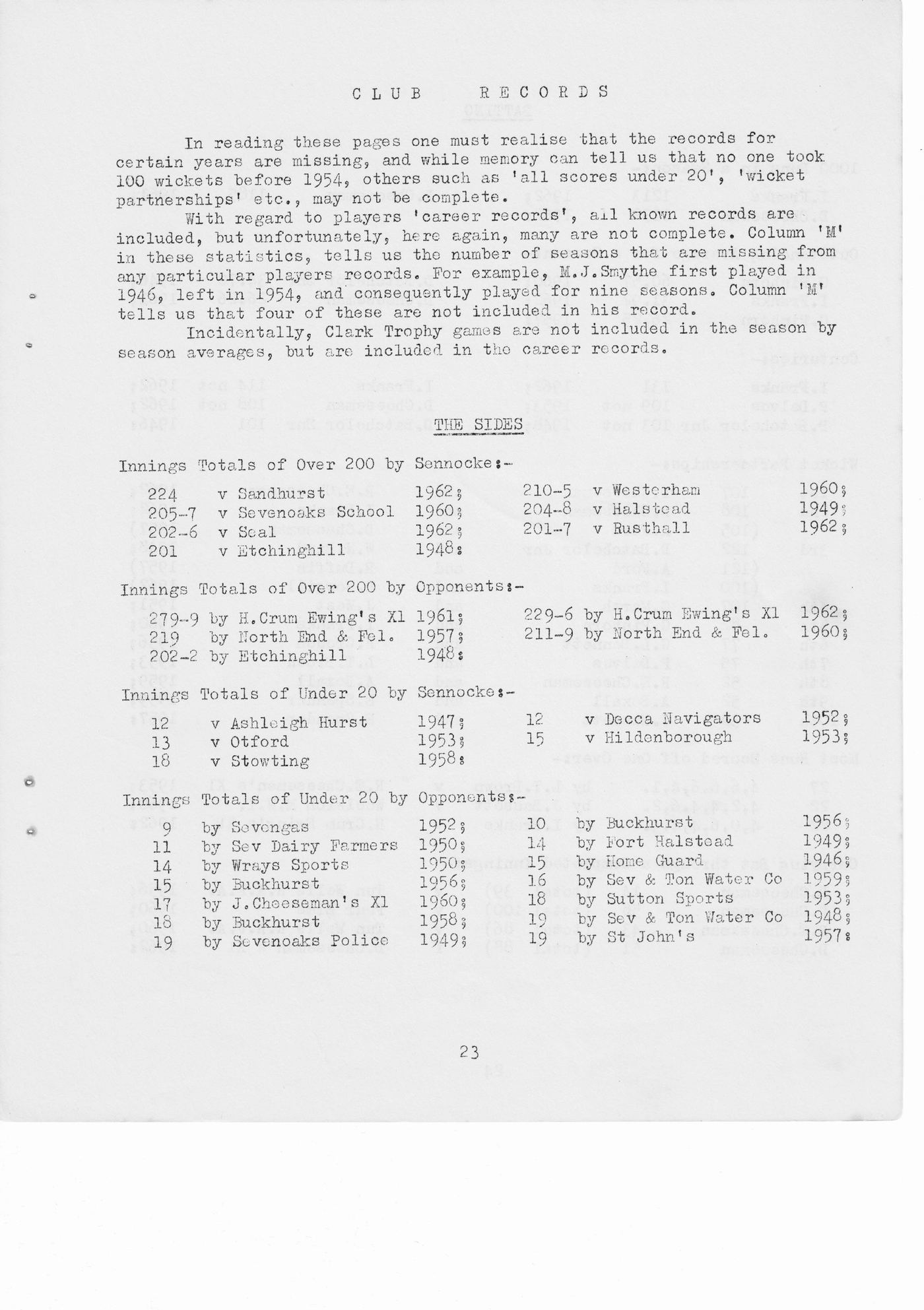
In reading these pages one must realise that the records for certain years are missing, and while memory can tell us that no one took 100 wickets before 1954, others such as 'all scores under 20', 'wicket partnerships' etc., may not be complete.
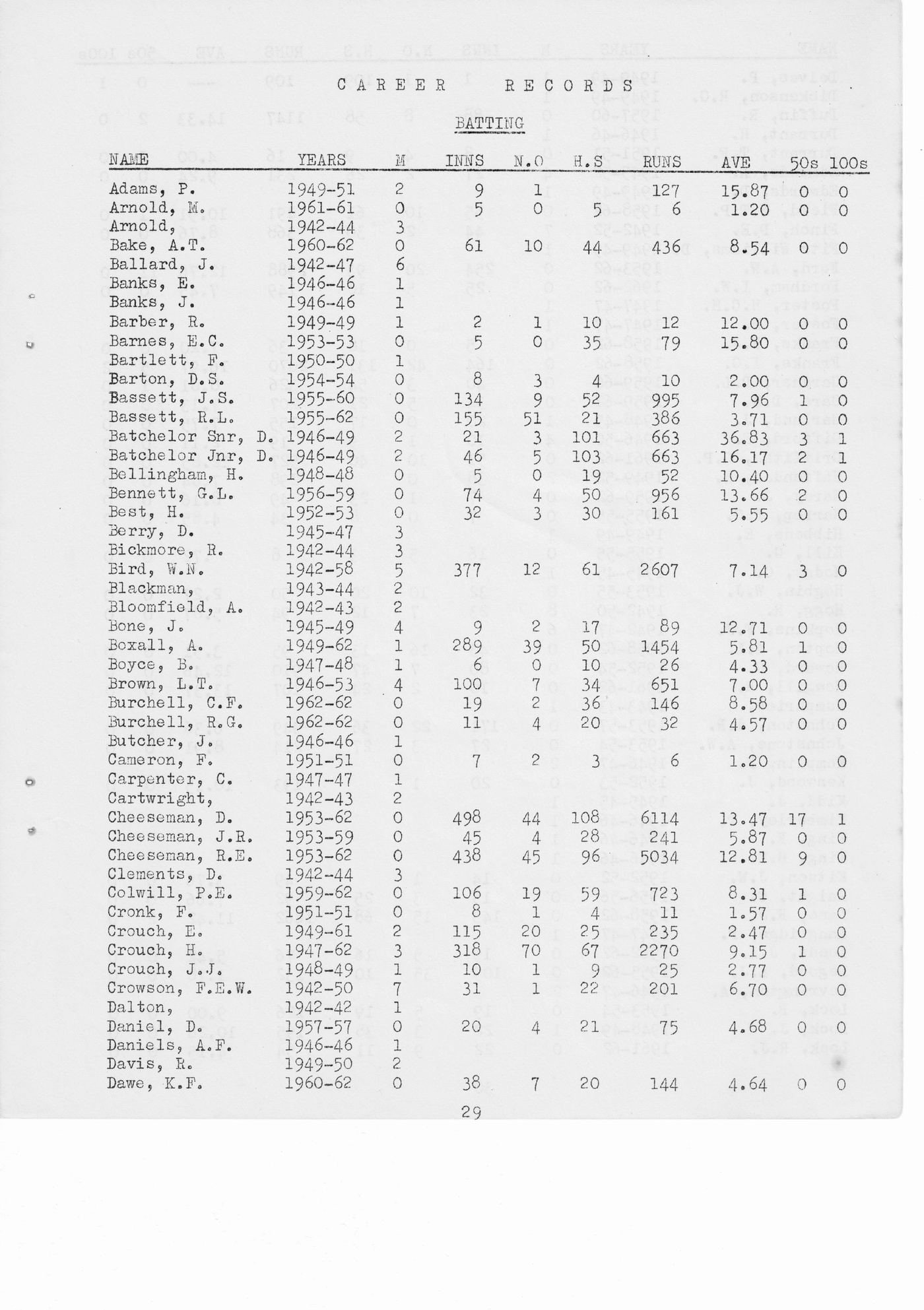
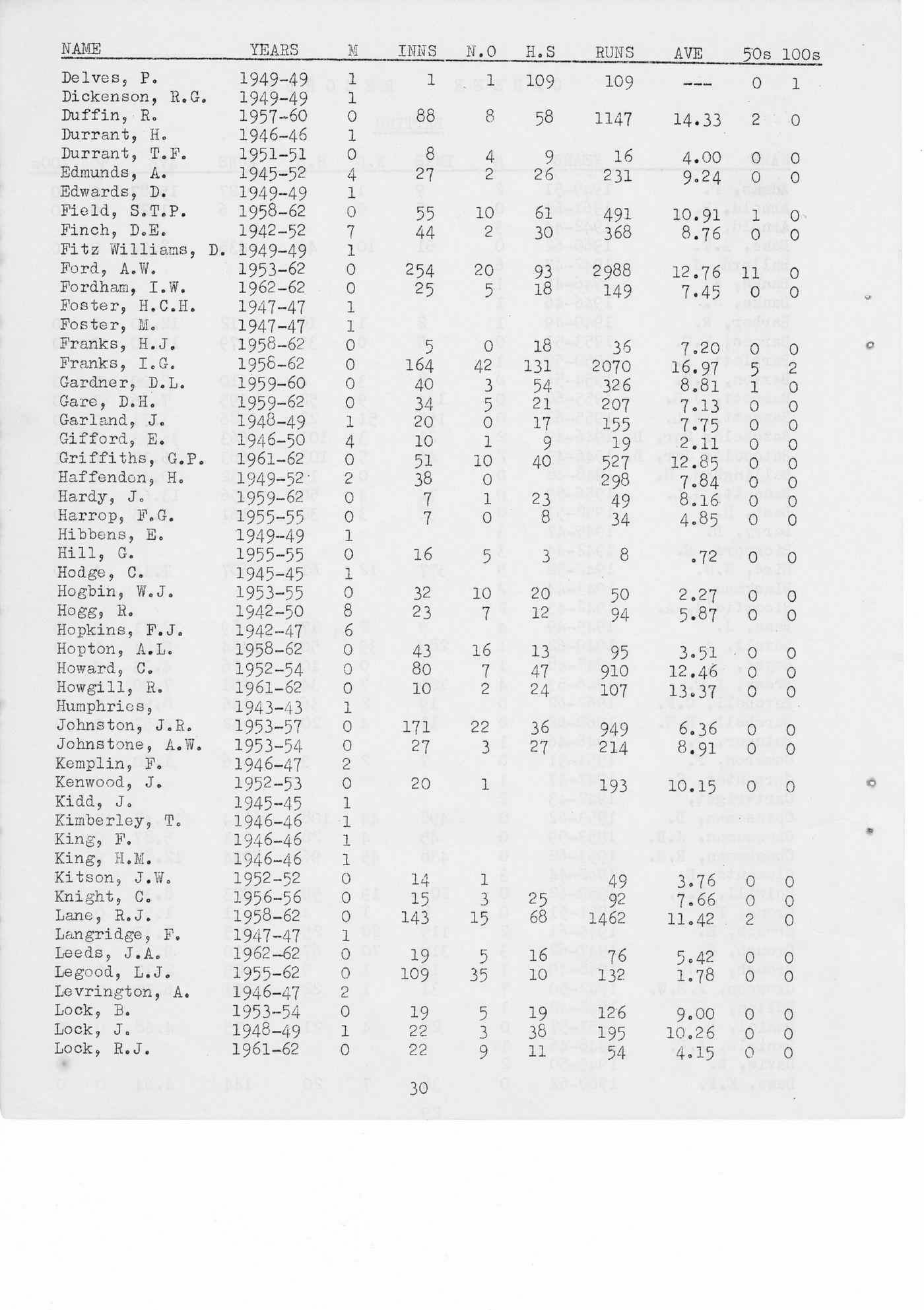
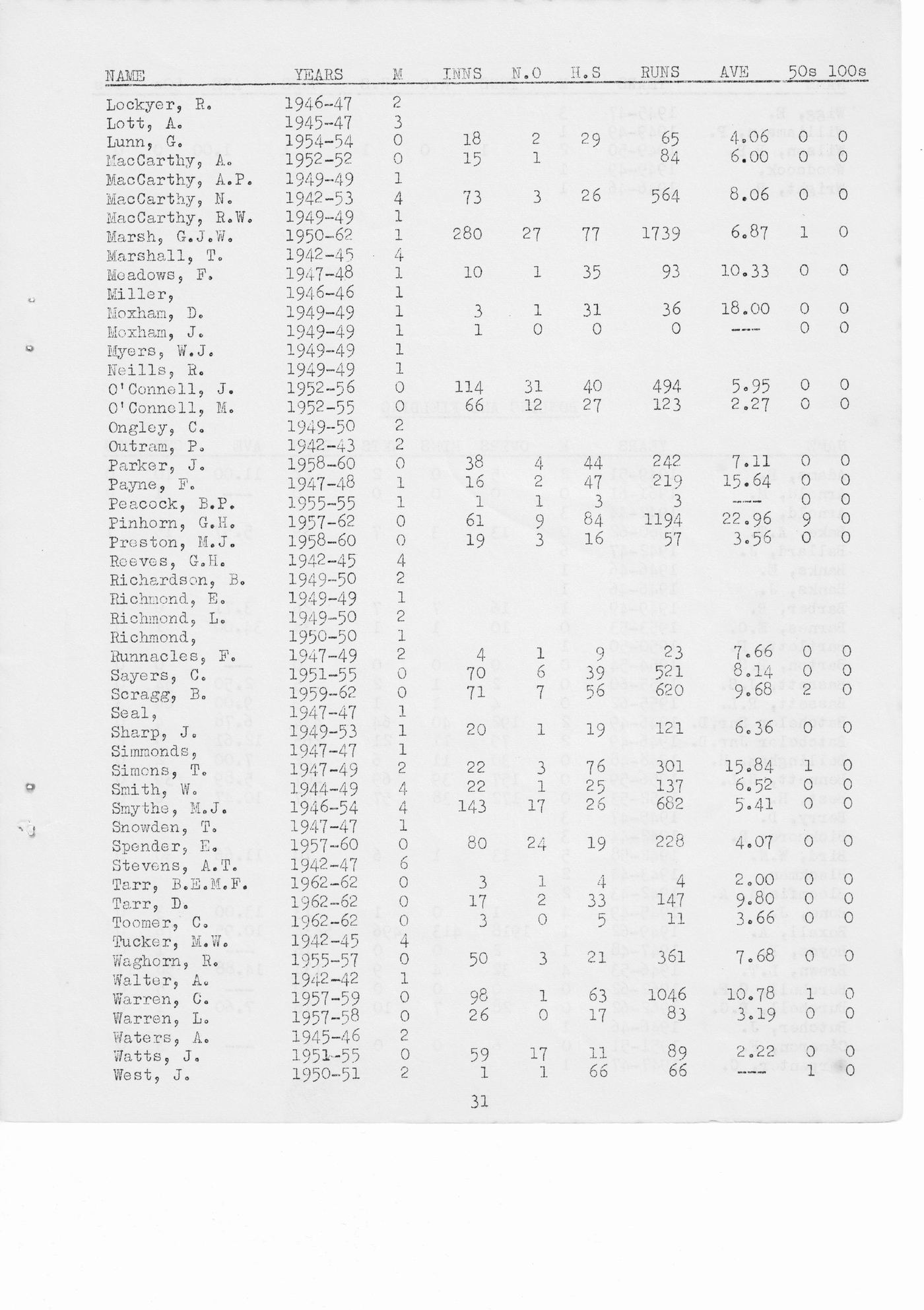
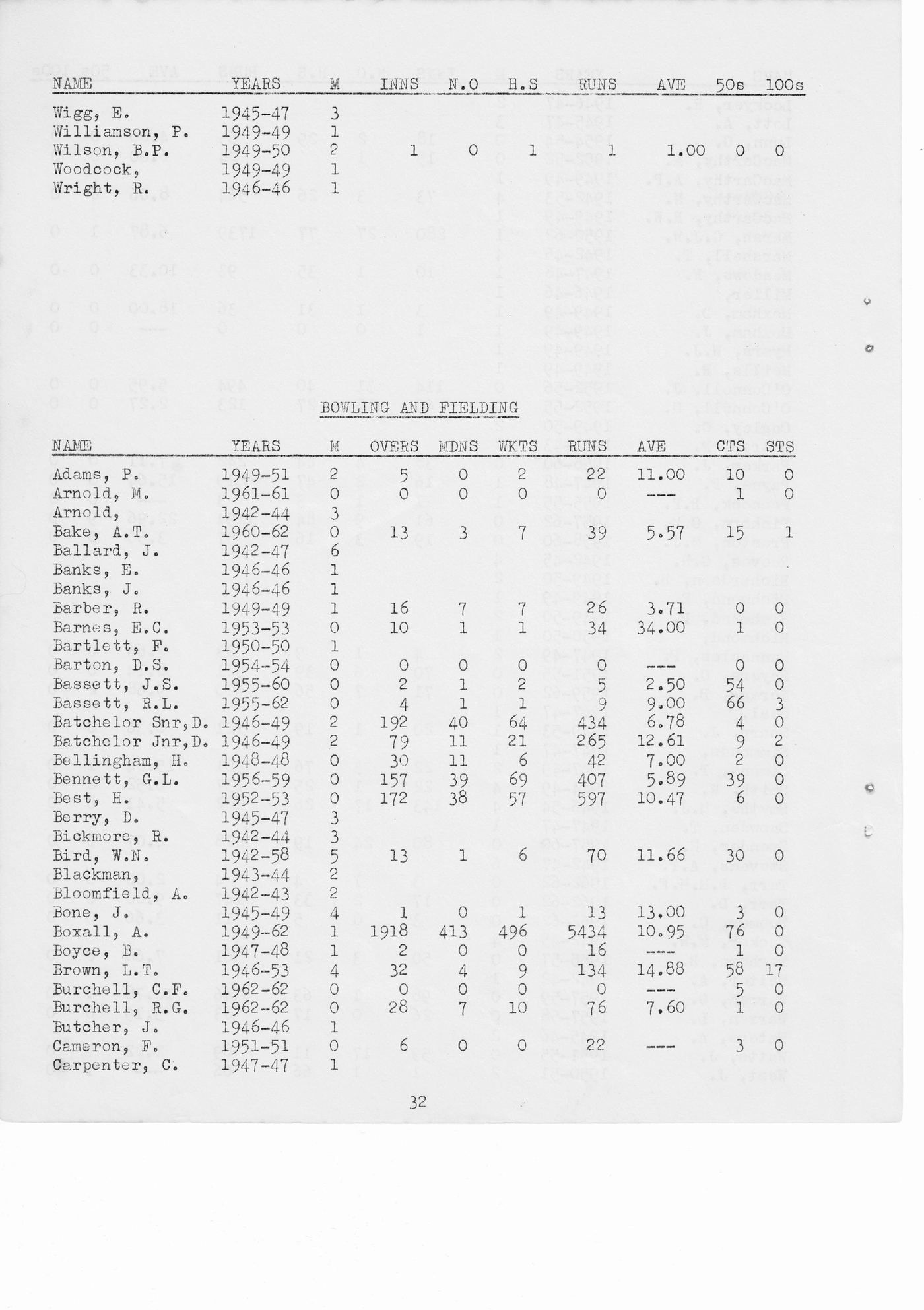
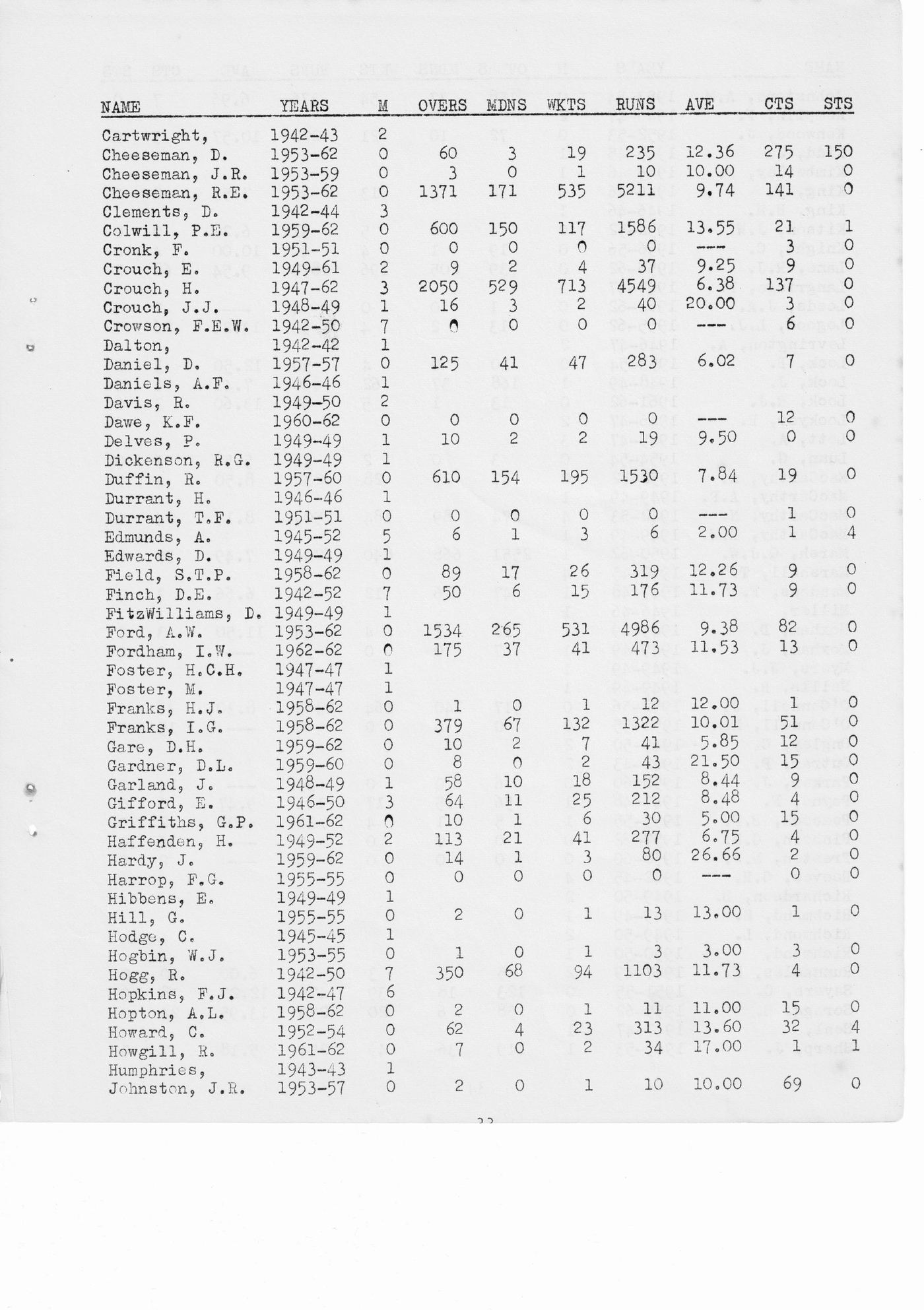
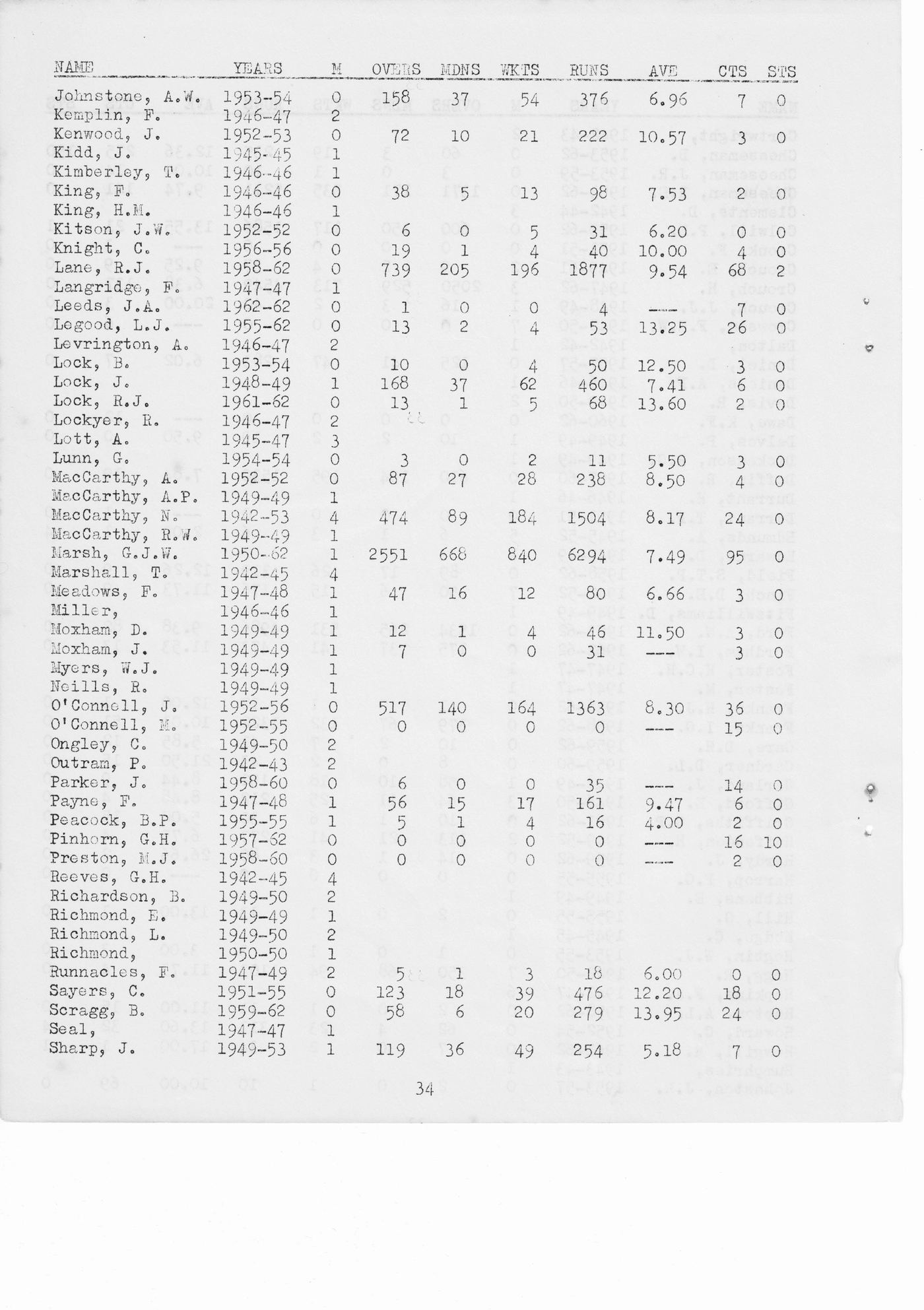
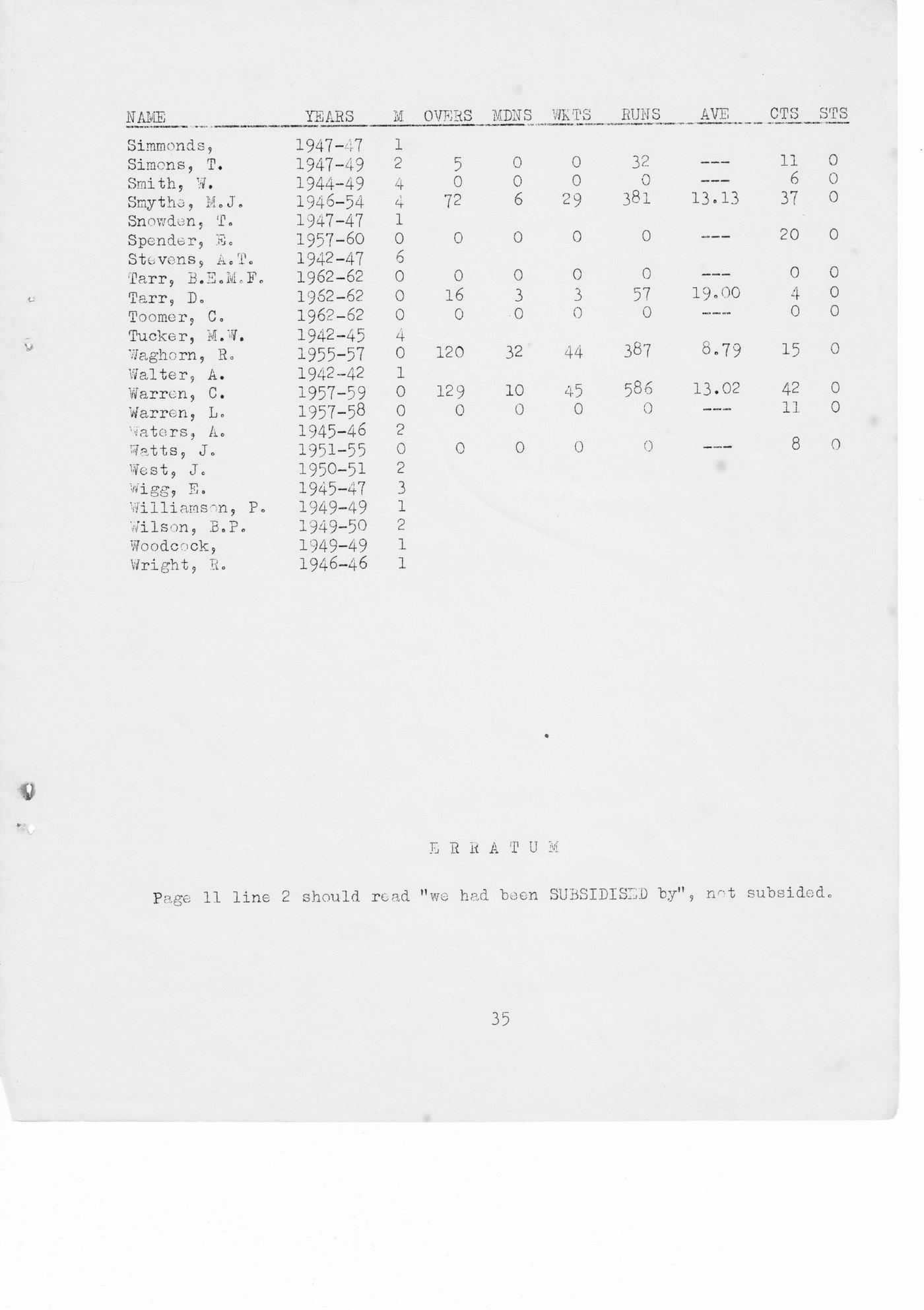
With regard to players 'career records', all known records are included, but unfortunately, here again, many are not complete. Column 'M' in these statistics, tells us the number of seasons that are missing from any particular players records. For example, M.J.Smythe first played in 1946, left in 1954, and consequently played for nine seasons. Column 'M' tells us that four of these are not included in his record.
Incidentally, Clark Trophy games are not included in the season by season averages, but are included in the career records.
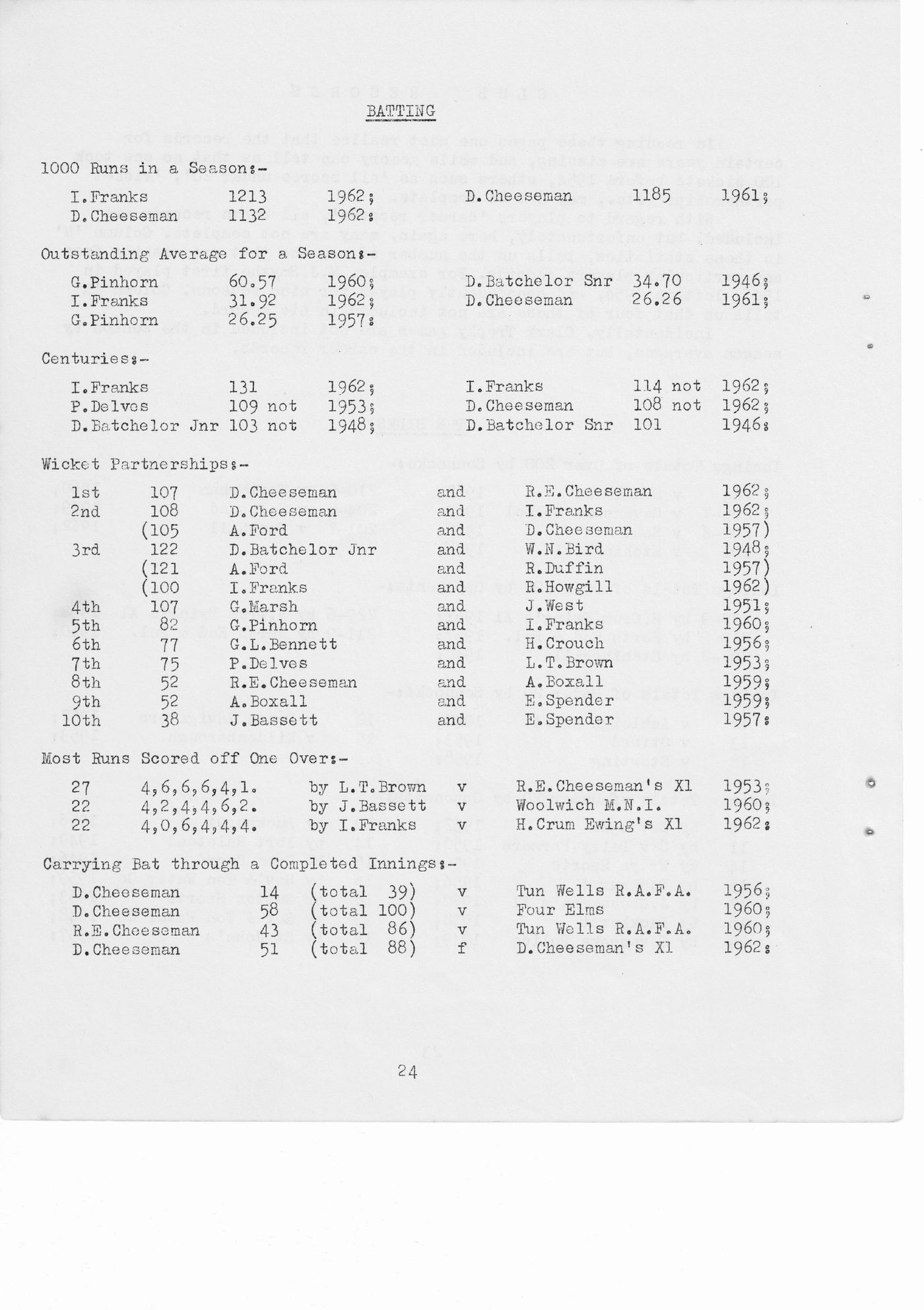
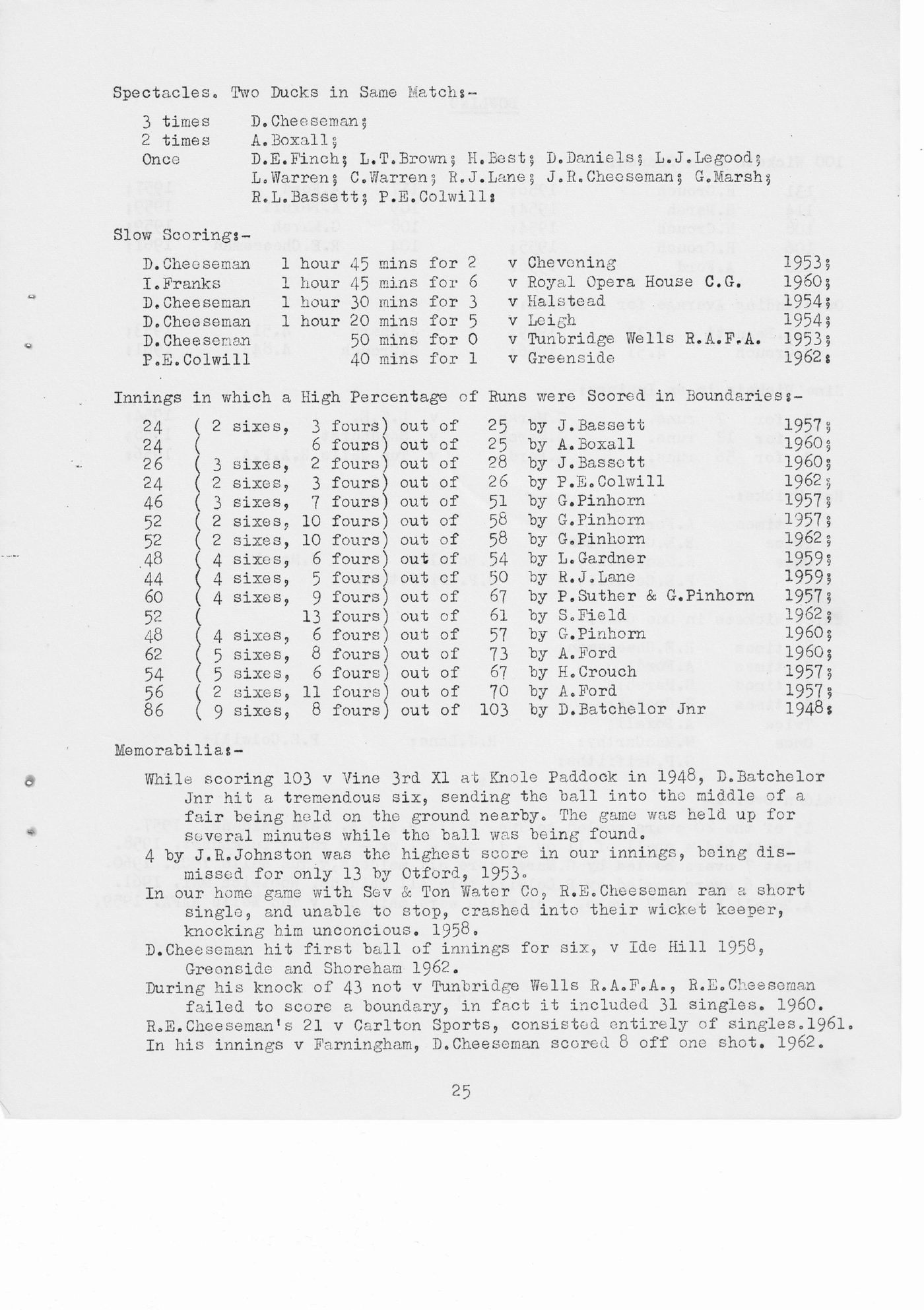
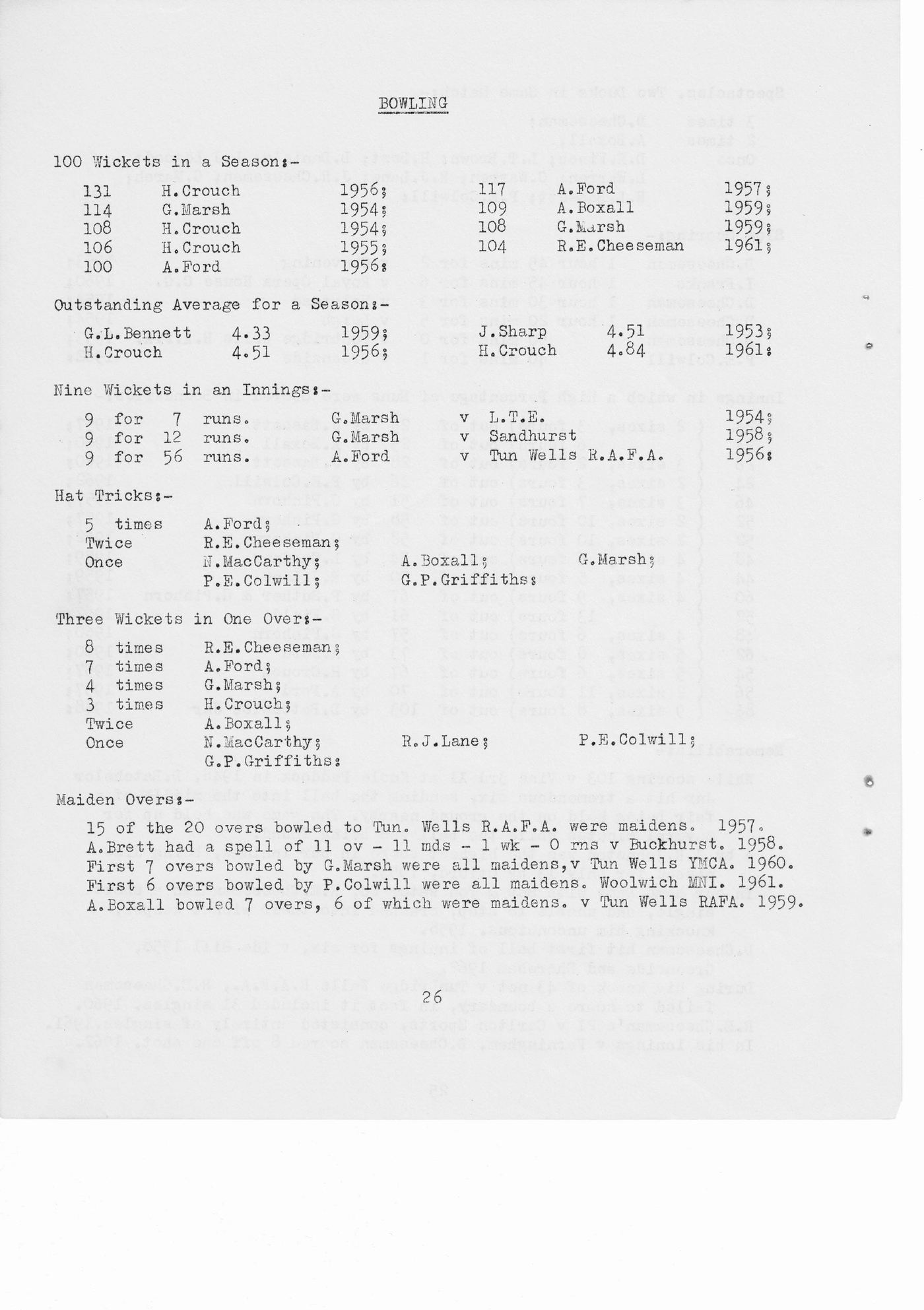
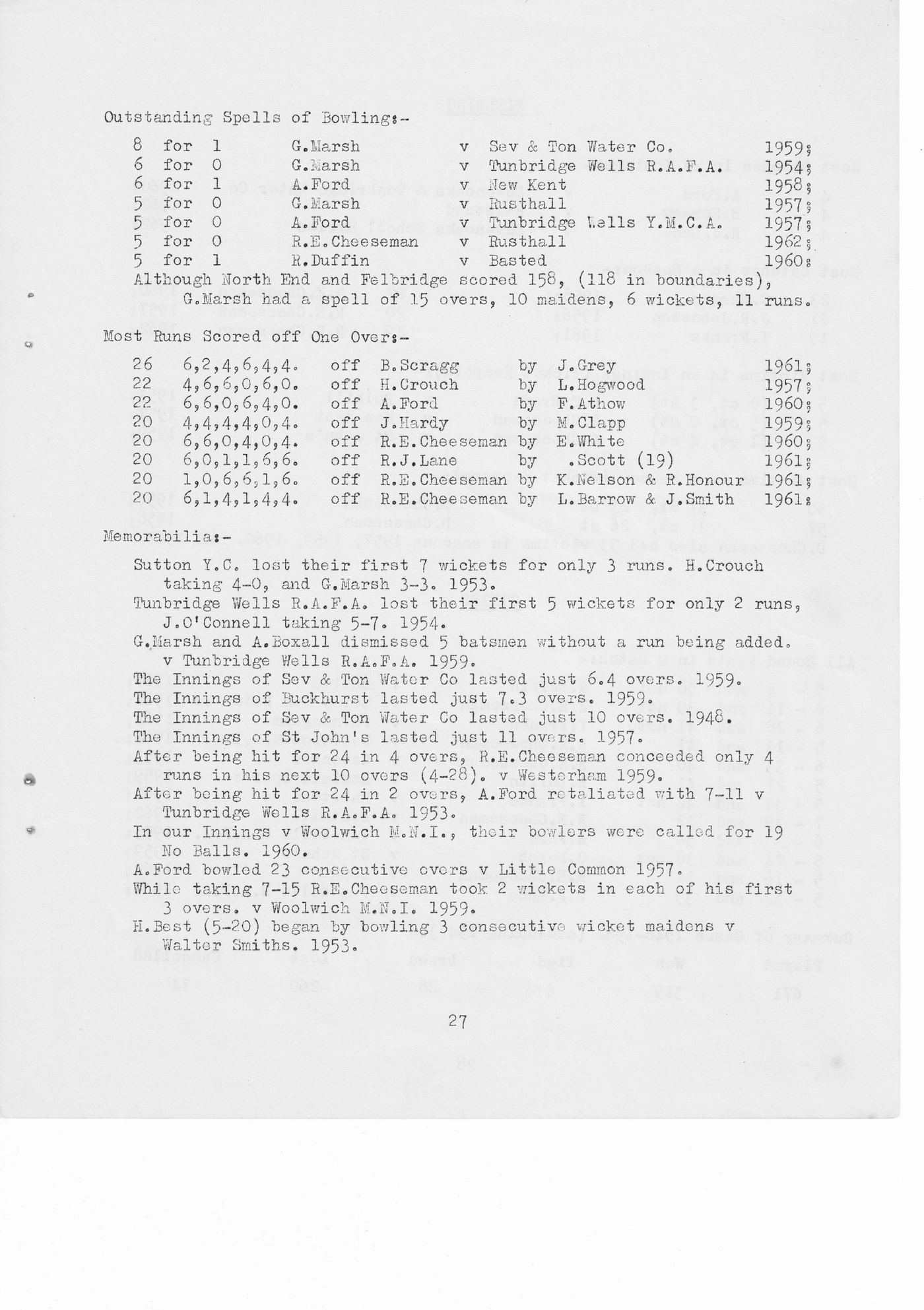
The tables below are transcribed from the original typed pages; figures and spellings are kept exactly as printed in 1963. Blank cells were blank in the original. The scanned pages can be opened at the end of each section.
The Sides
Innings totals of over 200 by Sennocke
| Score | Opponents | Year |
|---|---|---|
| 224 | v Sandhurst | 1962 |
| 210-5 | v Westerham | 1960 |
| 205-7 | v Sevenoaks School | 1960 |
| 204-8 | v Halstead | 1949 |
| 202-6 | v Seal | 1962 |
| 201-7 | v Rusthall | 1962 |
| 201 | v Etchinghill | 1948 |
Innings totals of over 200 by opponents
| Score | Opponents | Year |
|---|---|---|
| 279-9 | by H.Crum Ewing's XI | 1961 |
| 229-6 | by H.Crum Ewing's XI | 1962 |
| 219 | by North End & Fel. | 1957 |
| 211-9 | by North End & Fel. | 1960 |
| 202-2 | by Etchinghill | 1948 |
Innings totals of under 20 by Sennocke
| Score | Opponents | Year |
|---|---|---|
| 12 | v Ashleigh Hurst | 1947 |
| 12 | v Decca Navigators | 1952 |
| 13 | v Otford | 1953 |
| 15 | v Hildenborough | 1953 |
| 18 | v Stowting | 1958 |
Innings totals of under 20 by opponents
| Score | Opponents | Year |
|---|---|---|
| 9 | by Sevengas | 1952 |
| 10 | by Buckhurst | 1956 |
| 11 | by Sev Dairy Farmers | 1950 |
| 14 | by Fort Halstead | 1949 |
| 14 | by Wrays Sports | 1950 |
| 15 | by Home Guard | 1946 |
| 15 | by Buckhurst | 1956 |
| 16 | by Sev & Ton Water Co | 1959 |
| 17 | by J.Cheeseman's XI | 1960 |
| 18 | by Sutton Sports | 1953 |
| 18 | by Buckhurst | 1958 |
| 19 | by Sev & Ton Water Co | 1948 |
| 19 | by Sevenoaks Police | 1949 |
| 19 | by St John's | 1957 |
Batting
1000 runs in a season
| Runs | Player | Year |
|---|---|---|
| 1213 | I.Franks | 1962 |
| 1185 | D.Cheeseman | 1961 |
| 1132 | D.Cheeseman | 1962 |
Outstanding average for a season
| Average | Player | Year |
|---|---|---|
| 60.57 | G.Pinhorn | 1960 |
| 34.70 | D.Batchelor Snr | 1946 |
| 31.92 | I.Franks | 1962 |
| 26.26 | D.Cheeseman | 1961 |
| 26.25 | G.Pinhorn | 1957 |
Centuries
| Score | Player | Year |
|---|---|---|
| 131 | I.Franks | 1962 |
| 114 not out | I.Franks | 1962 |
| 109 not out | P.Delves | 1953 |
| 108 not out | D.Cheeseman | 1962 |
| 103 not out | D.Batchelor Jnr | 1948 |
| 101 | D.Batchelor Snr | 1946 |
Wicket partnerships
| Wicket | Runs | Partnership | Year |
|---|---|---|---|
| 1st | 107 | D.Cheeseman and R.E.Cheeseman | 1962 |
| 2nd | 108 | D.Cheeseman and I.Franks | 1962 |
| (105 | A.Ford and D.Cheeseman | 1957) | |
| 3rd | 122 | D.Batchelor Jnr and W.N.Bird | 1948 |
| (121 | A.Ford and R.Duffin | 1957) | |
| (100 | I.Franks and R.Howgill | 1962) | |
| 4th | 107 | G.Marsh and J.West | 1951 |
| 5th | 82 | G.Pinhorn and I.Franks | 1960 |
| 6th | 77 | G.L.Bennett and H.Crouch | 1956 |
| 7th | 75 | P.Delves and L.T.Brown | 1953 |
| 8th | 52 | R.E.Cheeseman and A.Boxall | 1959 |
| 9th | 52 | A.Boxall and E.Spender | 1959 |
| 10th | 38 | J.Bassett and E.Spender | 1957 |
Most runs scored off one over
| Runs | Over | Batsman | Opponents | Year |
|---|---|---|---|---|
| 27 | 4,6,6,6,4,1 | L.T.Brown | v R.E.Cheeseman's XI | 1953 |
| 22 | 4,2,4,4,6,2 | J.Bassett | v Woolwich M.N.I. | 1960 |
| 22 | 4,0,6,4,4,4 | I.Franks | v H.Crum Ewing's XI | 1962 |
Carrying bat through a completed innings
| Player | Score | Team total | Opponents | Year |
|---|---|---|---|---|
| D.Cheeseman | 14 | 39 | v Tun Wells R.A.F.A. | 1956 |
| D.Cheeseman | 58 | 100 | v Four Elms | 1960 |
| R.E.Cheeseman | 43 | 86 | v Tun Wells R.A.F.A. | 1960 |
| D.Cheeseman | 51 | 88 | for D.Cheeseman's XI | 1962 |
Spectacles — two ducks in the same match
| Times | Player(s) |
|---|---|
| 3 times | D.Cheeseman |
| 2 times | A.Boxall |
| Once | D.E.Finch; L.T.Brown; H.Best; D.Daniels; L.J.Legood; L.Warren; C.Warren; R.J.Lane; J.R.Cheeseman; G.Marsh; R.L.Bassett; P.E.Colwill |
Slow scoring
| Player | Vigil | Opponents | Year |
|---|---|---|---|
| D.Cheeseman | 1 hour 45 mins for 2 | v Chevening | 1953 |
| I.Franks | 1 hour 45 mins for 6 | v Royal Opera House C.G. | 1960 |
| D.Cheeseman | 1 hour 30 mins for 3 | v Halstead | 1954 |
| D.Cheeseman | 1 hour 20 mins for 5 | v Leigh | 1954 |
| D.Cheeseman | 50 mins for 0 | v Tunbridge Wells R.A.F.A. | 1953 |
| P.E.Colwill | 40 mins for 1 | v Greenside | 1962 |
Innings in which a high percentage of runs were scored in boundaries
| In boundaries | Detail | Out of | Batsman | Year |
|---|---|---|---|---|
| 24 | 2 sixes, 3 fours | 25 | J.Bassett | 1957 |
| 24 | 6 fours | 25 | A.Boxall | 1960 |
| 26 | 3 sixes, 2 fours | 28 | J.Bassett | 1960 |
| 24 | 2 sixes, 3 fours | 26 | P.E.Colwill | 1962 |
| 46 | 3 sixes, 7 fours | 51 | G.Pinhorn | 1957 |
| 52 | 2 sixes, 10 fours | 58 | G.Pinhorn | 1957 |
| 52 | 2 sixes, 10 fours | 58 | G.Pinhorn | 1962 |
| 48 | 4 sixes, 6 fours | 54 | L.Gardner | 1959 |
| 44 | 4 sixes, 5 fours | 50 | R.J.Lane | 1959 |
| 60 | 4 sixes, 9 fours | 67 | P.Suther & G.Pinhorn | 1957 |
| 52 | 13 fours | 61 | S.Field | 1962 |
| 48 | 4 sixes, 6 fours | 57 | G.Pinhorn | 1960 |
| 62 | 5 sixes, 8 fours | 73 | A.Ford | 1960 |
| 54 | 5 sixes, 6 fours | 67 | H.Crouch | 1957 |
| 56 | 2 sixes, 11 fours | 70 | A.Ford | 1957 |
| 86 | 9 sixes, 8 fours | 103 | D.Batchelor Jnr | 1948 |
Memorabilia
- While scoring 103 v Vine 3rd XI at Knole Paddock in 1948, D.Batchelor Jnr hit a tremendous six, sending the ball into the middle of a fair being held on the ground nearby. The game was held up for several minutes while the ball was being found.
- 4 by J.R.Johnston was the highest score in our innings, being dismissed for only 13 by Otford, 1953.
- In our home game with Sev & Ton Water Co, R.E.Cheeseman ran a short single, and unable to stop, crashed into their wicket keeper, knocking him unconcious. 1958.
- D.Cheeseman hit first ball of innings for six, v Ide Hill 1958, Greenside and Shoreham 1962.
- During his knock of 43 not v Tunbridge Wells R.A.F.A., R.E.Cheeseman failed to score a boundary, in fact it included 31 singles. 1960.
- R.E.Cheeseman's 21 v Carlton Sports, consisted entirely of singles. 1961.
- In his innings v Farningham, D.Cheeseman scored 8 off one shot. 1962.
Bowling
100 wickets in a season
| Wickets | Player | Year |
|---|---|---|
| 131 | H.Crouch | 1956 |
| 117 | A.Ford | 1957 |
| 114 | G.Marsh | 1954 |
| 109 | A.Boxall | 1959 |
| 108 | H.Crouch | 1954 |
| 108 | G.Marsh | 1959 |
| 106 | H.Crouch | 1955 |
| 104 | R.E.Cheeseman | 1961 |
| 100 | A.Ford | 1956 |
Outstanding average for a season
| Average | Player | Year |
|---|---|---|
| 4.33 | G.L.Bennett | 1959 |
| 4.51 | H.Crouch | 1956 |
| 4.51 | J.Sharp | 1953 |
| 4.84 | H.Crouch | 1961 |
Nine wickets in an innings
| Figures | Player | Opponents | Year |
|---|---|---|---|
| 9 for 7 runs | G.Marsh | v L.T.E. | 1954 |
| 9 for 12 runs | G.Marsh | v Sandhurst | 1958 |
| 9 for 56 runs | A.Ford | v Tun Wells R.A.F.A. | 1956 |
Hat tricks
| Times | Player(s) |
|---|---|
| 5 times | A.Ford |
| Twice | R.E.Cheeseman |
| Once | N.MacCarthy; A.Boxall; G.Marsh; P.E.Colwill; G.P.Griffiths |
Three wickets in one over
| Times | Player(s) |
|---|---|
| 8 times | R.E.Cheeseman |
| 7 times | A.Ford |
| 4 times | G.Marsh |
| 3 times | H.Crouch |
| Twice | A.Boxall |
| Once | N.MacCarthy; R.J.Lane; P.E.Colwill; G.P.Griffiths |
Maiden overs
- 15 of the 20 overs bowled to Tun. Wells R.A.F.A. were maidens. 1957.
- A.Brett had a spell of 11 ov - 11 mds - 1 wk - 0 rns v Buckhurst. 1958.
- First 7 overs bowled by G.Marsh were all maidens, v Tun Wells YMCA. 1960.
- First 6 overs bowled by P.Colwill were all maidens. Woolwich MNI. 1961.
- A.Boxall bowled 7 overs, 6 of which were maidens. v Tun Wells RAFA. 1959.
Outstanding spells of bowling
| Figures | Player | Opponents | Year |
|---|---|---|---|
| 8 for 1 | G.Marsh | v Sev & Ton Water Co. | 1959 |
| 6 for 0 | G.Marsh | v Tunbridge Wells R.A.F.A. | 1954 |
| 6 for 1 | A.Ford | v New Kent | 1958 |
| 5 for 0 | G.Marsh | v Rusthall | 1957 |
| 5 for 0 | A.Ford | v Tunbridge Wells Y.M.C.A. | 1957 |
| 5 for 0 | R.E.Cheeseman | v Rusthall | 1962 |
| 5 for 1 | R.Duffin | v Basted | 1960 |
Although North End and Felbridge scored 158, (118 in boundaries), G.Marsh had a spell of 15 overs, 10 maidens, 6 wickets, 11 runs.
Most runs scored off one over (conceded)
| Runs | Over | Bowler | Hit by | Year |
|---|---|---|---|---|
| 26 | 6,2,4,6,4,4 | off B.Scragg | by J.Grey | 1961 |
| 22 | 4,6,6,0,6,0 | off H.Crouch | by L.Hogwood | 1957 |
| 22 | 6,6,0,6,4,0 | off A.Ford | by F.Athow | 1960 |
| 20 | 4,4,4,4,0,4 | off J.Hardy | by M.Clapp | 1959 |
| 20 | 6,6,0,4,0,4 | off R.E.Cheeseman | by E.White | 1960 |
| 20 | 6,0,1,1,6,6 | off R.J.Lane | by .Scott (19) | 1961 |
| 20 | 1,0,6,6,1,6 | off R.E.Cheeseman | by K.Nelson & R.Honour | 1961 |
| 20 | 6,1,4,1,4,4 | off R.E.Cheeseman | by L.Barrow & J.Smith | 1961 |
Memorabilia
- Sutton Y.C. lost their first 7 wickets for only 3 runs. H.Crouch taking 4-0, and G.Marsh 3-3. 1953.
- Tunbridge Wells R.A.F.A. lost their first 5 wickets for only 2 runs, J.O'Connell taking 5-7. 1954.
- G.Marsh and A.Boxall dismissed 5 batsmen without a run being added. v Tunbridge Wells R.A.F.A. 1959.
- The Innings of Sev & Ton Water Co lasted just 6.4 overs. 1959.
- The Innings of Buckhurst lasted just 7.3 overs. 1959.
- The Innings of Sev & Ton Water Co lasted just 10 overs. 1948.
- The Innings of St John's lasted just 11 overs. 1957.
- After being hit for 24 in 4 overs, R.E.Cheeseman conceeded only 4 runs in his next 10 overs (4-28). v Westerham 1959.
- After being hit for 24 in 2 overs, A.Ford retaliated with 7-11 v Tunbridge Wells R.A.F.A. 1953.
- In our Innings v Woolwich M.N.I., their bowlers were called for 19 No Balls. 1960.
- A.Ford bowled 23 consecutive overs v Little Common 1957.
- While taking 7-15 R.E.Cheeseman took 2 wickets in each of his first 3 overs. v Woolwich M.N.I. 1959.
- H.Best (5-20) began by bowling 3 consecutive wicket maidens v Walter Smiths. 1953.
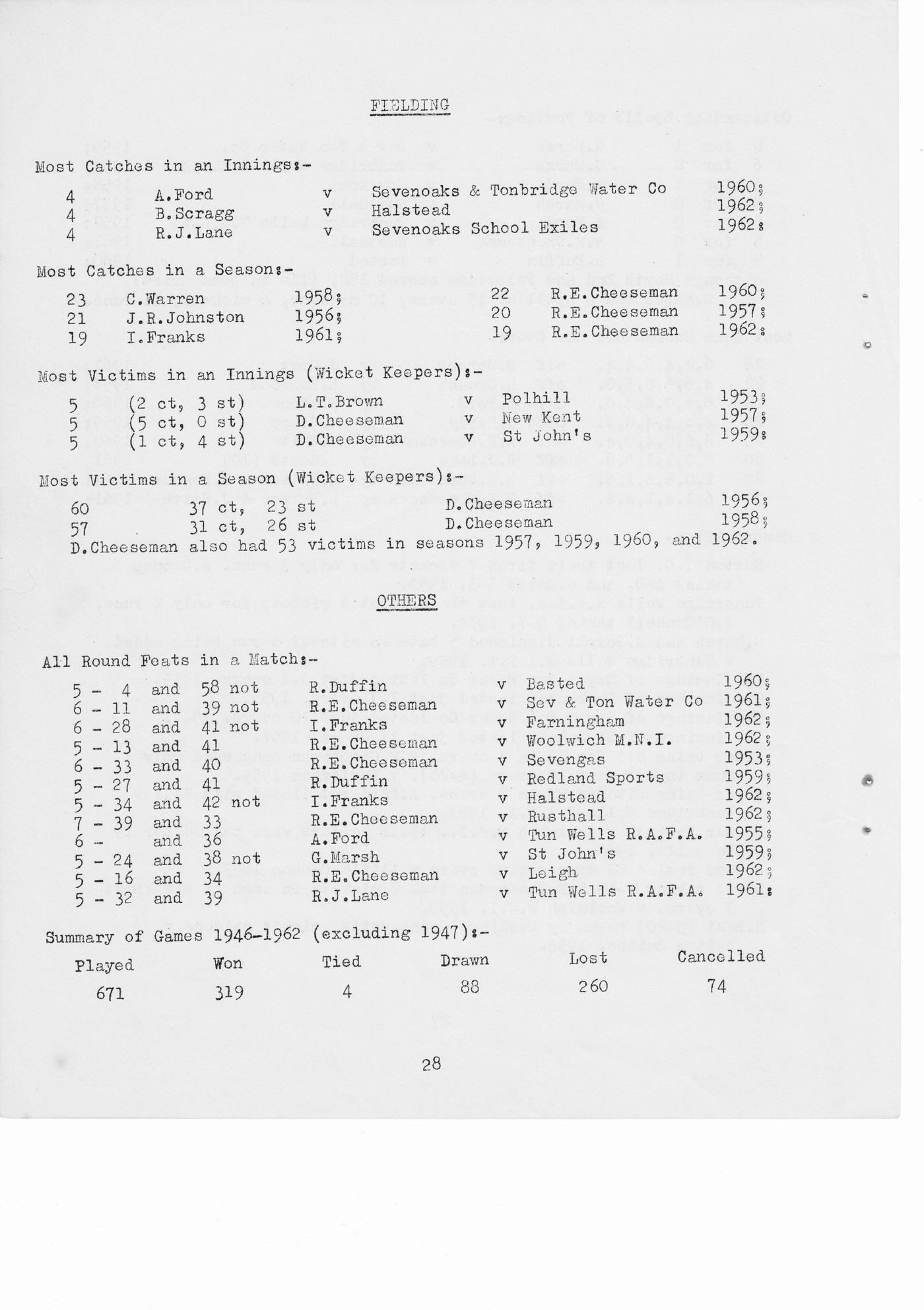
Fielding
Most catches in an innings
| Catches | Player | Opponents | Year |
|---|---|---|---|
| 4 | A.Ford | v Sevenoaks & Tonbridge Water Co | 1960 |
| 4 | B.Scragg | v Halstead | 1962 |
| 4 | R.J.Lane | v Sevenoaks School Exiles | 1962 |
Most catches in a season
| Catches | Player | Year |
|---|---|---|
| 23 | C.Warren | 1958 |
| 22 | R.E.Cheeseman | 1960 |
| 21 | J.R.Johnston | 1956 |
| 20 | R.E.Cheeseman | 1957 |
| 19 | I.Franks | 1961 |
| 19 | R.E.Cheeseman | 1962 |
Most victims in an innings (wicket keepers)
| Victims | Detail | Player | Opponents | Year |
|---|---|---|---|---|
| 5 | 2 ct, 3 st | L.T.Brown | v Polhill | 1953 |
| 5 | 5 ct, 0 st | D.Cheeseman | v New Kent | 1957 |
| 5 | 1 ct, 4 st | D.Cheeseman | v St John's | 1959 |
Most victims in a season (wicket keepers)
| Victims | Detail | Player | Year |
|---|---|---|---|
| 60 | 37 ct, 23 st | D.Cheeseman | 1956 |
| 57 | 31 ct, 26 st | D.Cheeseman | 1958 |
D.Cheeseman also had 53 victims in seasons 1957, 1959, 1960, and 1962.
Others
All round feats in a match
| Bowling | Batting | Player | Opponents | Year |
|---|---|---|---|---|
| 5 - 4 | 58 not out | R.Duffin | v Basted | 1960 |
| 6 - 11 | 39 not out | R.E.Cheeseman | v Sev & Ton Water Co | 1961 |
| 6 - 28 | 41 not out | I.Franks | v Farningham | 1962 |
| 5 - 13 | 41 | R.E.Cheeseman | v Woolwich M.N.I. | 1962 |
| 6 - 33 | 40 | R.E.Cheeseman | v Sevengas | 1953 |
| 5 - 27 | 41 | R.Duffin | v Redland Sports | 1959 |
| 5 - 34 | 42 not out | I.Franks | v Halstead | 1962 |
| 7 - 39 | 33 | R.E.Cheeseman | v Rusthall | 1962 |
| 6 - | 36 | A.Ford | v Tun Wells R.A.F.A. | 1955 |
| 5 - 24 | 38 not out | G.Marsh | v St John's | 1959 |
| 5 - 16 | 34 | R.E.Cheeseman | v Leigh | 1962 |
| 5 - 32 | 39 | R.J.Lane | v Tun Wells R.A.F.A. | 1961 |
Summary of games 1946–1962 (excluding 1947)
| Played | Won | Tied | Drawn | Lost | Cancelled |
|---|---|---|---|---|---|
| 671 | 319 | 4 | 88 | 260 | 74 |
View the original typed pages (23–28)
Career Records
Column 'M' is the number of seasons missing from a player's record (see the note above). Blank cells were blank in the original. A dash in the average column appears where the booklet printed one (no completed innings, or no wickets).
Batting
| Name | Years | M | Inns | N.O. | H.S. | Runs | Ave | 50s | 100s |
|---|---|---|---|---|---|---|---|---|---|
| Adams, P. | 1949-51 | 2 | 9 | 1 | 127 | 15.87 | 0 | 0 | |
| Arnold, M. | 1961-61 | 0 | 5 | 0 | 5 | 6 | 1.20 | 0 | 0 |
| Arnold, | 1942-44 | 3 | |||||||
| Bake, A.T. | 1960-62 | 0 | 61 | 10 | 44 | 436 | 8.54 | 0 | 0 |
| Ballard, J. | 1942-47 | 6 | |||||||
| Banks, E. | 1946-46 | 1 | |||||||
| Banks, J. | 1946-46 | 1 | |||||||
| Barber, R. | 1949-49 | 1 | 2 | 1 | 10 | 12 | 12.00 | 0 | 0 |
| Barnes, E.C. | 1953-53 | 0 | 5 | 0 | 35 | 79 | 15.80 | 0 | 0 |
| Bartlett, F. | 1950-50 | 1 | |||||||
| Barton, D.S. | 1954-54 | 0 | 8 | 3 | 4 | 10 | 2.00 | 0 | 0 |
| Bassett, J.S. | 1955-60 | 0 | 134 | 9 | 52 | 995 | 7.96 | 1 | 0 |
| Bassett, R.L. | 1955-62 | 0 | 155 | 51 | 21 | 386 | 3.71 | 0 | 0 |
| Batchelor Snr, D. | 1946-49 | 2 | 21 | 3 | 101 | 663 | 36.83 | 3 | 1 |
| Batchelor Jnr, D. | 1946-49 | 2 | 46 | 5 | 103 | 663 | 16.17 | 2 | 1 |
| Bellingham, H. | 1948-48 | 0 | 5 | 0 | 19 | 52 | 10.40 | 0 | 0 |
| Bennett, G.L. | 1956-59 | 0 | 74 | 4 | 50 | 956 | 13.66 | 2 | 0 |
| Best, H. | 1952-53 | 0 | 32 | 3 | 30 | 161 | 5.55 | 0 | 0 |
| Berry, D. | 1945-47 | 3 | |||||||
| Bickmore, R. | 1942-44 | 3 | |||||||
| Bird, W.N. | 1942-58 | 5 | 377 | 12 | 61 | 2607 | 7.14 | 3 | 0 |
| Blackman, | 1943-44 | 2 | |||||||
| Bloomfield, A. | 1942-43 | 2 | |||||||
| Bone, J. | 1945-49 | 4 | 9 | 2 | 17 | 89 | 12.71 | 0 | 0 |
| Boxall, A. | 1949-62 | 1 | 289 | 39 | 50 | 1454 | 5.81 | 1 | 0 |
| Boyce, B. | 1947-48 | 1 | 6 | 0 | 10 | 26 | 4.33 | 0 | 0 |
| Brown, L.T. | 1946-53 | 4 | 100 | 7 | 34 | 651 | 7.00 | 0 | 0 |
| Burchell, C.F. | 1962-62 | 0 | 19 | 2 | 36 | 146 | 8.58 | 0 | 0 |
| Burchell, R.G. | 1962-62 | 0 | 11 | 4 | 20 | 32 | 4.57 | 0 | 0 |
| Butcher, J. | 1946-46 | 1 | |||||||
| Cameron, F. | 1951-51 | 0 | 7 | 2 | 3 | 6 | 1.20 | 0 | 0 |
| Carpenter, C. | 1947-47 | 1 | |||||||
| Cartwright, | 1942-43 | 2 | |||||||
| Cheeseman, D. | 1953-62 | 0 | 498 | 44 | 108 | 6114 | 13.47 | 17 | 1 |
| Cheeseman, J.R. | 1953-59 | 0 | 45 | 4 | 28 | 241 | 5.87 | 0 | 0 |
| Cheeseman, R.E. | 1953-62 | 0 | 438 | 45 | 96 | 5034 | 12.81 | 9 | 0 |
| Clements, D. | 1942-44 | 3 | |||||||
| Colwill, P.E. | 1959-62 | 0 | 106 | 19 | 59 | 723 | 8.31 | 1 | 0 |
| Cronk, F. | 1951-51 | 0 | 8 | 1 | 4 | 11 | 1.57 | 0 | 0 |
| Crouch, E. | 1949-61 | 2 | 115 | 20 | 25 | 235 | 2.47 | 0 | 0 |
| Crouch, H. | 1947-62 | 3 | 318 | 70 | 67 | 2270 | 9.15 | 1 | 0 |
| Crouch, J.J. | 1948-49 | 1 | 10 | 1 | 9 | 25 | 2.77 | 0 | 0 |
| Crowson, F.E.W. | 1942-50 | 7 | 31 | 1 | 22 | 201 | 6.70 | 0 | 0 |
| Dalton, | 1942-42 | 1 | |||||||
| Daniel, D. | 1957-57 | 0 | 20 | 4 | 21 | 75 | 4.68 | 0 | 0 |
| Daniels, A.F. | 1946-46 | 1 | |||||||
| Davis, R. | 1949-50 | 2 | |||||||
| Dawe, K.F. | 1960-62 | 0 | 38 | 7 | 20 | 144 | 4.64 | 0 | 0 |
| Delves, P. | 1949-49 | 1 | 1 | 1 | 109 | 109 | — | 0 | 1 |
| Dickenson, R.G. | 1949-49 | 1 | |||||||
| Duffin, R. | 1957-60 | 0 | 88 | 8 | 58 | 1147 | 14.33 | 2 | 0 |
| Durrant, H. | 1946-46 | 1 | |||||||
| Durrant, T.F. | 1951-51 | 0 | 8 | 4 | 9 | 16 | 4.00 | 0 | 0 |
| Edmunds, A. | 1945-52 | 4 | 27 | 2 | 26 | 231 | 9.24 | 0 | 0 |
| Edwards, D. | 1949-49 | 1 | |||||||
| Field, S.T.P. | 1958-62 | 0 | 55 | 10 | 61 | 491 | 10.91 | 1 | 0 |
| Finch, D.E. | 1942-52 | 7 | 44 | 2 | 30 | 368 | 8.76 | 0 | 0 |
| Fitz Williams, D. | 1949-49 | 1 | |||||||
| Ford, A.W. | 1953-62 | 0 | 254 | 20 | 93 | 2988 | 12.76 | 11 | 0 |
| Fordham, I.W. | 1962-62 | 0 | 25 | 5 | 18 | 149 | 7.45 | 0 | 0 |
| Foster, H.C.H. | 1947-47 | 1 | |||||||
| Foster, M. | 1947-47 | 1 | |||||||
| Franks, H.J. | 1958-62 | 0 | 5 | 0 | 18 | 36 | 7.20 | 0 | 0 |
| Franks, I.G. | 1958-62 | 0 | 164 | 42 | 131 | 2070 | 16.97 | 5 | 2 |
| Gardner, D.L. | 1959-60 | 0 | 40 | 3 | 54 | 326 | 8.81 | 1 | 0 |
| Gare, D.H. | 1959-62 | 0 | 34 | 5 | 21 | 207 | 7.13 | 0 | 0 |
| Garland, J. | 1948-49 | 1 | 20 | 0 | 17 | 155 | 7.75 | 0 | 0 |
| Gifford, E. | 1946-50 | 4 | 10 | 1 | 9 | 19 | 2.11 | 0 | 0 |
| Griffiths, G.P. | 1961-62 | 0 | 51 | 10 | 40 | 527 | 12.85 | 0 | 0 |
| Haffenden, H. | 1949-52 | 2 | 38 | 0 | 298 | 7.84 | 0 | 0 | |
| Hardy, J. | 1959-62 | 0 | 7 | 1 | 23 | 49 | 8.16 | 0 | 0 |
| Harrop, F.G. | 1955-55 | 0 | 7 | 0 | 8 | 34 | 4.85 | 0 | 0 |
| Hibbens, E. | 1949-49 | 1 | |||||||
| Hill, G. | 1955-55 | 0 | 16 | 5 | 3 | 8 | .72 | 0 | 0 |
| Hodge, C. | 1945-45 | 1 | |||||||
| Hogbin, W.J. | 1953-55 | 0 | 32 | 10 | 20 | 50 | 2.27 | 0 | 0 |
| Hogg, R. | 1942-50 | 8 | 23 | 7 | 12 | 94 | 5.87 | 0 | 0 |
| Hopkins, F.J. | 1942-47 | 6 | |||||||
| Hopton, A.L. | 1958-62 | 0 | 43 | 16 | 13 | 95 | 3.51 | 0 | 0 |
| Howard, C. | 1952-54 | 0 | 80 | 7 | 47 | 910 | 12.46 | 0 | 0 |
| Howgill, R. | 1961-62 | 0 | 10 | 2 | 24 | 107 | 13.37 | 0 | 0 |
| Humphries, | 1943-43 | 1 | |||||||
| Johnston, J.R. | 1953-57 | 0 | 171 | 22 | 36 | 949 | 6.36 | 0 | 0 |
| Johnstone, A.W. | 1953-54 | 0 | 27 | 3 | 27 | 214 | 8.91 | 0 | 0 |
| Kemplin, F. | 1946-47 | 2 | |||||||
| Kenwood, J. | 1952-53 | 0 | 20 | 1 | 193 | 10.15 | 0 | 0 | |
| Kidd, J. | 1945-45 | 1 | |||||||
| Kimberley, T. | 1946-46 | 1 | |||||||
| King, F. | 1946-46 | 1 | |||||||
| King, H.M. | 1946-46 | 1 | |||||||
| Kitson, J.W. | 1952-52 | 0 | 14 | 1 | 49 | 3.76 | 0 | 0 | |
| Knight, C. | 1956-56 | 0 | 15 | 3 | 25 | 92 | 7.66 | 0 | 0 |
| Lane, R.J. | 1958-62 | 0 | 143 | 15 | 68 | 1462 | 11.42 | 2 | 0 |
| Langridge, F. | 1947-47 | 1 | |||||||
| Leeds, J.A. | 1962-62 | 0 | 19 | 5 | 16 | 76 | 5.42 | 0 | 0 |
| Legood, L.J. | 1955-62 | 0 | 109 | 35 | 10 | 132 | 1.78 | 0 | 0 |
| Levrington, A. | 1946-47 | 2 | |||||||
| Lock, B. | 1953-54 | 0 | 19 | 5 | 19 | 126 | 9.00 | 0 | 0 |
| Lock, J. | 1948-49 | 1 | 22 | 3 | 38 | 195 | 10.26 | 0 | 0 |
| Lock, R.J. | 1961-62 | 0 | 22 | 9 | 11 | 54 | 4.15 | 0 | 0 |
| Lockyer, R. | 1946-47 | 2 | |||||||
| Lott, A. | 1945-47 | 3 | |||||||
| Lunn, G. | 1954-54 | 0 | 18 | 2 | 29 | 65 | 4.06 | 0 | 0 |
| MacCarthy, A. | 1952-52 | 0 | 15 | 1 | 84 | 6.00 | 0 | 0 | |
| MacCarthy, A.P. | 1949-49 | 1 | |||||||
| MacCarthy, N. | 1942-53 | 4 | 73 | 3 | 26 | 564 | 8.06 | 0 | 0 |
| MacCarthy, R.W. | 1949-49 | 1 | |||||||
| Marsh, G.J.W. | 1950-62 | 1 | 280 | 27 | 77 | 1739 | 6.87 | 1 | 0 |
| Marshall, T. | 1942-45 | 4 | |||||||
| Meadows, F. | 1947-48 | 1 | 10 | 1 | 35 | 93 | 10.33 | 0 | 0 |
| Miller, | 1946-46 | 1 | |||||||
| Moxham, D. | 1949-49 | 1 | 3 | 1 | 31 | 36 | 18.00 | 0 | 0 |
| Moxham, J. | 1949-49 | 1 | 1 | 0 | 0 | 0 | — | 0 | 0 |
| Myers, W.J. | 1949-49 | 1 | |||||||
| Neills, R. | 1949-49 | 1 | |||||||
| O'Connell, J. | 1952-56 | 0 | 114 | 31 | 40 | 494 | 5.95 | 0 | 0 |
| O'Connell, M. | 1952-55 | 0 | 66 | 12 | 27 | 123 | 2.27 | 0 | 0 |
| Ongley, C. | 1949-50 | 2 | |||||||
| Outram, P. | 1942-43 | 2 | |||||||
| Parker, J. | 1958-60 | 0 | 38 | 4 | 44 | 242 | 7.11 | 0 | 0 |
| Payne, F. | 1947-48 | 1 | 16 | 2 | 47 | 219 | 15.64 | 0 | 0 |
| Peacock, B.P. | 1955-55 | 1 | 1 | 1 | 3 | 3 | — | 0 | 0 |
| Pinhorn, G.H. | 1957-62 | 0 | 61 | 9 | 84 | 1194 | 22.96 | 9 | 0 |
| Preston, M.J. | 1958-60 | 0 | 19 | 3 | 16 | 57 | 3.56 | 0 | 0 |
| Reeves, G.H. | 1942-45 | 4 | |||||||
| Richardson, B. | 1949-50 | 2 | |||||||
| Richmond, E. | 1949-49 | 1 | |||||||
| Richmond, L. | 1949-50 | 2 | |||||||
| Richmond, | 1950-50 | 1 | |||||||
| Runnacles, F. | 1947-49 | 2 | 4 | 1 | 9 | 23 | 7.66 | 0 | 0 |
| Sayers, C. | 1951-55 | 0 | 70 | 6 | 39 | 521 | 8.14 | 0 | 0 |
| Scragg, B. | 1959-62 | 0 | 71 | 7 | 56 | 620 | 9.68 | 2 | 0 |
| Seal, | 1947-47 | 1 | |||||||
| Sharp, J. | 1949-53 | 1 | 20 | 1 | 19 | 121 | 6.36 | 0 | 0 |
| Simmonds, | 1947-47 | 1 | |||||||
| Simons, T. | 1947-49 | 2 | 22 | 3 | 76 | 301 | 15.84 | 1 | 0 |
| Smith, W. | 1944-49 | 4 | 22 | 1 | 25 | 137 | 6.52 | 0 | 0 |
| Smythe, M.J. | 1946-54 | 4 | 143 | 17 | 26 | 682 | 5.41 | 0 | 0 |
| Snowden, T. | 1947-47 | 1 | |||||||
| Spender, E. | 1957-60 | 0 | 80 | 24 | 19 | 228 | 4.07 | 0 | 0 |
| Stevens, A.T. | 1942-47 | 6 | |||||||
| Tarr, B.E.M.F. | 1962-62 | 0 | 3 | 1 | 4 | 4 | 2.00 | 0 | 0 |
| Tarr, D. | 1962-62 | 0 | 17 | 2 | 33 | 147 | 9.80 | 0 | 0 |
| Toomer, C. | 1962-62 | 0 | 3 | 0 | 5 | 11 | 3.66 | 0 | 0 |
| Tucker, M.W. | 1942-45 | 4 | |||||||
| Waghorn, R. | 1955-57 | 0 | 50 | 3 | 21 | 361 | 7.68 | 0 | 0 |
| Walter, A. | 1942-42 | 1 | |||||||
| Warren, C. | 1957-59 | 0 | 98 | 1 | 63 | 1046 | 10.78 | 1 | 0 |
| Warren, L. | 1957-58 | 0 | 26 | 0 | 17 | 83 | 3.19 | 0 | 0 |
| Waters, A. | 1945-46 | 2 | |||||||
| Watts, J. | 1951-55 | 0 | 59 | 17 | 11 | 89 | 2.22 | 0 | 0 |
| West, J. | 1950-51 | 2 | 1 | 1 | 66 | 66 | — | 1 | 0 |
| Wigg, E. | 1945-47 | 3 | |||||||
| Williamson, P. | 1949-49 | 1 | |||||||
| Wilson, B.P. | 1949-50 | 2 | 1 | 0 | 1 | 1 | 1.00 | 0 | 0 |
| Woodcock, | 1949-49 | 1 | |||||||
| Wright, R. | 1946-46 | 1 |
Bowling and Fielding
| Name | Years | M | Overs | Mdns | Wkts | Runs | Ave | Cts | Sts |
|---|---|---|---|---|---|---|---|---|---|
| Adams, P. | 1949-51 | 2 | 5 | 0 | 2 | 22 | 11.00 | 10 | 0 |
| Arnold, M. | 1961-61 | 0 | 0 | 0 | 0 | 0 | — | 1 | 0 |
| Arnold, | 1942-44 | 3 | |||||||
| Bake, A.T. | 1960-62 | 0 | 13 | 3 | 7 | 39 | 5.57 | 15 | 1 |
| Ballard, J. | 1942-47 | 6 | |||||||
| Banks, E. | 1946-46 | 1 | |||||||
| Banks, J. | 1946-46 | 1 | |||||||
| Barber, R. | 1949-49 | 1 | 16 | 7 | 7 | 26 | 3.71 | 0 | 0 |
| Barnes, E.C. | 1953-53 | 0 | 10 | 1 | 1 | 34 | 34.00 | 1 | 0 |
| Bartlett, F. | 1950-50 | 1 | |||||||
| Barton, D.S. | 1954-54 | 0 | 0 | 0 | 0 | 0 | — | 0 | 0 |
| Bassett, J.S. | 1955-60 | 0 | 2 | 1 | 2 | 5 | 2.50 | 54 | 0 |
| Bassett, R.L. | 1955-62 | 0 | 4 | 1 | 1 | 9 | 9.00 | 66 | 3 |
| Batchelor Snr, D. | 1946-49 | 2 | 192 | 40 | 64 | 434 | 6.78 | 4 | 0 |
| Batchelor Jnr, D. | 1946-49 | 2 | 79 | 11 | 21 | 265 | 12.61 | 9 | 2 |
| Bellingham, H. | 1948-48 | 0 | 30 | 11 | 6 | 42 | 7.00 | 2 | 0 |
| Bennett, G.L. | 1956-59 | 0 | 157 | 39 | 69 | 407 | 5.89 | 39 | 0 |
| Best, H. | 1952-53 | 0 | 172 | 38 | 57 | 597 | 10.47 | 6 | 0 |
| Berry, D. | 1945-47 | 3 | |||||||
| Bickmore, R. | 1942-44 | 3 | |||||||
| Bird, W.N. | 1942-58 | 5 | 13 | 1 | 6 | 70 | 11.66 | 30 | 0 |
| Blackman, | 1943-44 | 2 | |||||||
| Bloomfield, A. | 1942-43 | 2 | |||||||
| Bone, J. | 1945-49 | 4 | 1 | 0 | 1 | 13 | 13.00 | 3 | 0 |
| Boxall, A. | 1949-62 | 1 | 1918 | 413 | 496 | 5434 | 10.95 | 76 | 0 |
| Boyce, B. | 1947-48 | 1 | 2 | 0 | 0 | 16 | — | 1 | 0 |
| Brown, L.T. | 1946-53 | 4 | 32 | 4 | 9 | 134 | 14.88 | 58 | 17 |
| Burchell, C.F. | 1962-62 | 0 | 0 | 0 | 0 | 0 | — | 5 | 0 |
| Burchell, R.G. | 1962-62 | 0 | 28 | 7 | 10 | 76 | 7.60 | 1 | 0 |
| Butcher, J. | 1946-46 | 1 | |||||||
| Cameron, F. | 1951-51 | 0 | 6 | 0 | 0 | 22 | — | 3 | 0 |
| Carpenter, C. | 1947-47 | 1 | |||||||
| Cartwright, | 1942-43 | 2 | |||||||
| Cheeseman, D. | 1953-62 | 0 | 60 | 3 | 19 | 235 | 12.36 | 275 | 150 |
| Cheeseman, J.R. | 1953-59 | 0 | 3 | 0 | 1 | 10 | 10.00 | 14 | 0 |
| Cheeseman, R.E. | 1953-62 | 0 | 1371 | 171 | 535 | 5211 | 9.74 | 141 | 0 |
| Clements, D. | 1942-44 | 3 | |||||||
| Colwill, P.E. | 1959-62 | 0 | 600 | 150 | 117 | 1586 | 13.55 | 21 | 1 |
| Cronk, F. | 1951-51 | 0 | 0 | 0 | 0 | 0 | — | 3 | 0 |
| Crouch, E. | 1949-61 | 2 | 9 | 2 | 4 | 37 | 9.25 | 9 | 0 |
| Crouch, H. | 1947-62 | 3 | 2050 | 529 | 713 | 4549 | 6.38 | 137 | 0 |
| Crouch, J.J. | 1948-49 | 1 | 16 | 3 | 2 | 40 | 20.00 | 3 | 0 |
| Crowson, F.E.W. | 1942-50 | 7 | 0 | 0 | 0 | 0 | — | 6 | 0 |
| Dalton, | 1942-42 | 1 | |||||||
| Daniel, D. | 1957-57 | 0 | 125 | 41 | 47 | 283 | 6.02 | 7 | 0 |
| Daniels, A.F. | 1946-46 | 1 | |||||||
| Davis, R. | 1949-50 | 2 | |||||||
| Dawe, K.F. | 1960-62 | 0 | 0 | 0 | 0 | 0 | — | 12 | 0 |
| Delves, P. | 1949-49 | 1 | 10 | 2 | 2 | 19 | 9.50 | 0 | 0 |
| Dickenson, R.G. | 1949-49 | 1 | |||||||
| Duffin, R. | 1957-60 | 0 | 610 | 154 | 195 | 1530 | 7.84 | 19 | 0 |
| Durrant, H. | 1946-46 | 1 | |||||||
| Durrant, T.F. | 1951-51 | 0 | 0 | 0 | 0 | 0 | — | 1 | 0 |
| Edmunds, A. | 1945-52 | 5 | 6 | 1 | 3 | 6 | 2.00 | 1 | 4 |
| Edwards, D. | 1949-49 | 1 | |||||||
| Field, S.T.P. | 1958-62 | 0 | 89 | 17 | 26 | 319 | 12.26 | 9 | 0 |
| Finch, D.E. | 1942-52 | 7 | 50 | 6 | 15 | 176 | 11.73 | 9 | 0 |
| FitzWilliams, D. | 1949-49 | 1 | |||||||
| Ford, A.W. | 1953-62 | 0 | 1534 | 265 | 531 | 4986 | 9.38 | 82 | 0 |
| Fordham, I.W. | 1962-62 | 0 | 175 | 37 | 41 | 473 | 11.53 | 13 | 0 |
| Foster, H.C.H. | 1947-47 | 1 | |||||||
| Foster, M. | 1947-47 | 1 | |||||||
| Franks, H.J. | 1958-62 | 0 | 1 | 0 | 1 | 12 | 12.00 | 1 | 0 |
| Franks, I.G. | 1958-62 | 0 | 379 | 67 | 132 | 1322 | 10.01 | 51 | 0 |
| Gare, D.H. | 1959-62 | 0 | 10 | 2 | 7 | 41 | 5.85 | 12 | 0 |
| Gardner, D.L. | 1959-60 | 0 | 8 | 0 | 2 | 43 | 21.50 | 15 | 0 |
| Garland, J. | 1948-49 | 1 | 58 | 10 | 18 | 152 | 8.44 | 9 | 0 |
| Gifford, E. | 1946-50 | 3 | 64 | 11 | 25 | 212 | 8.48 | 4 | 0 |
| Griffiths, G.P. | 1961-62 | 0 | 10 | 1 | 6 | 30 | 5.00 | 15 | 0 |
| Haffenden, H. | 1949-52 | 2 | 113 | 21 | 41 | 277 | 6.75 | 4 | 0 |
| Hardy, J. | 1959-62 | 0 | 14 | 1 | 3 | 80 | 26.66 | 2 | 0 |
| Harrop, F.G. | 1955-55 | 0 | 0 | 0 | 0 | 0 | — | 0 | 0 |
| Hibbens, E. | 1949-49 | 1 | |||||||
| Hill, G. | 1955-55 | 0 | 2 | 0 | 1 | 13 | 13.00 | 1 | 0 |
| Hodge, C. | 1945-45 | 1 | |||||||
| Hogbin, W.J. | 1953-55 | 0 | 1 | 0 | 1 | 3 | 3.00 | 3 | 0 |
| Hogg, R. | 1942-50 | 7 | 350 | 68 | 94 | 1103 | 11.73 | 4 | 0 |
| Hopkins, F.J. | 1942-47 | 6 | |||||||
| Hopton, A.L. | 1958-62 | 0 | 2 | 0 | 1 | 11 | 11.00 | 15 | 0 |
| Howard, C. | 1952-54 | 0 | 62 | 4 | 23 | 313 | 13.60 | 32 | 4 |
| Howgill, R. | 1961-62 | 0 | 7 | 0 | 2 | 34 | 17.00 | 1 | 1 |
| Humphries, | 1943-43 | 1 | |||||||
| Johnston, J.R. | 1953-57 | 0 | 2 | 0 | 1 | 10 | 10.00 | 69 | 0 |
| Johnstone, A.W. | 1953-54 | 0 | 158 | 37 | 54 | 376 | 6.96 | 7 | 0 |
| Kemplin, F. | 1946-47 | 2 | |||||||
| Kenwood, J. | 1952-53 | 0 | 72 | 10 | 21 | 222 | 10.57 | 3 | 0 |
| Kidd, J. | 1945-45 | 1 | |||||||
| Kimberley, T. | 1946-46 | 1 | |||||||
| King, F. | 1946-46 | 0 | 38 | 5 | 13 | 98 | 7.53 | 2 | 0 |
| King, H.M. | 1946-46 | 1 | |||||||
| Kitson, J.W. | 1952-52 | 0 | 6 | 0 | 5 | 31 | 6.20 | 1 | 0 |
| Knight, C. | 1956-56 | 0 | 19 | 1 | 4 | 40 | 10.00 | 4 | 0 |
| Lane, R.J. | 1958-62 | 0 | 739 | 205 | 196 | 1877 | 9.54 | 68 | 2 |
| Langridge, F. | 1947-47 | 1 | |||||||
| Leeds, J.A. | 1962-62 | 0 | 1 | 0 | 0 | 4 | — | 7 | 0 |
| Legood, L.J. | 1955-62 | 0 | 13 | 2 | 4 | 53 | 13.25 | 26 | 0 |
| Levrington, A. | 1946-47 | 2 | |||||||
| Lock, B. | 1953-54 | 0 | 10 | 0 | 4 | 50 | 12.50 | 3 | 0 |
| Lock, J. | 1948-49 | 1 | 168 | 37 | 62 | 460 | 7.41 | 6 | 0 |
| Lock, R.J. | 1961-62 | 0 | 13 | 1 | 5 | 68 | 13.60 | 2 | 0 |
| Lockyer, R. | 1946-47 | 2 | |||||||
| Lott, A. | 1945-47 | 3 | |||||||
| Lunn, G. | 1954-54 | 0 | 3 | 0 | 2 | 11 | 5.50 | 1 | 2 |
| MacCarthy, A. | 1952-52 | 0 | 87 | 27 | 28 | 238 | 8.50 | 4 | 0 |
| MacCarthy, A.P. | 1949-49 | 1 | |||||||
| MacCarthy, N. | 1942-53 | 4 | 474 | 89 | 184 | 1504 | 8.17 | 24 | 0 |
| MacCarthy, R.W. | 1949-49 | 1 | |||||||
| Marsh, G.J.W. | 1950-62 | 1 | 2551 | 668 | 840 | 6294 | 7.49 | 95 | 0 |
| Marshall, T. | 1942-45 | 4 | |||||||
| Meadows, F. | 1947-48 | 1 | 47 | 16 | 12 | 80 | 6.66 | 3 | 0 |
| Miller, | 1946-46 | 1 | |||||||
| Moxham, D. | 1949-49 | 1 | 12 | 1 | 4 | 46 | 11.50 | 3 | 0 |
| Moxham, J. | 1949-49 | 1 | 7 | 0 | 0 | 31 | — | 3 | 0 |
| Myers, W.J. | 1949-49 | 1 | |||||||
| Neills, R. | 1949-49 | 1 | |||||||
| O'Connell, J. | 1952-56 | 0 | 517 | 140 | 164 | 1363 | 8.30 | 36 | 0 |
| O'Connell, M. | 1952-55 | 0 | 0 | 0 | 0 | 0 | — | 15 | 0 |
| Ongley, C. | 1949-50 | 2 | |||||||
| Outram, P. | 1942-43 | 2 | |||||||
| Parker, J. | 1958-60 | 0 | 6 | 0 | 0 | 35 | — | 14 | 0 |
| Payne, F. | 1947-48 | 1 | 56 | 15 | 17 | 161 | 9.47 | 6 | 0 |
| Peacock, B.P. | 1955-55 | 1 | 5 | 1 | 4 | 16 | 4.00 | 2 | 0 |
| Pinhorn, G.H. | 1957-62 | 0 | 0 | 0 | 0 | 0 | — | 16 | 10 |
| Preston, M.J. | 1958-60 | 0 | 0 | 0 | 0 | 0 | — | 2 | 0 |
| Reeves, G.H. | 1942-45 | 4 | |||||||
| Richardson, B. | 1949-50 | 2 | |||||||
| Richmond, E. | 1949-49 | 1 | |||||||
| Richmond, L. | 1949-50 | 2 | |||||||
| Richmond, | 1950-50 | 1 | |||||||
| Runnacles, F. | 1947-49 | 2 | 5 | 1 | 3 | 18 | 6.00 | 0 | 0 |
| Sayers, C. | 1951-55 | 0 | 123 | 18 | 39 | 476 | 12.20 | 18 | 0 |
| Scragg, B. | 1959-62 | 0 | 58 | 6 | 20 | 279 | 13.95 | 24 | 0 |
| Seal, | 1947-47 | 1 | |||||||
| Sharp, J. | 1949-53 | 1 | 119 | 36 | 49 | 254 | 5.18 | 7 | 0 |
| Simmonds, | 1947-47 | 1 | |||||||
| Simons, T. | 1947-49 | 2 | 5 | 0 | 0 | 32 | — | 11 | 0 |
| Smith, W. | 1944-49 | 4 | 0 | 0 | 0 | 0 | — | 6 | 0 |
| Smythe, M.J. | 1946-54 | 4 | 72 | 6 | 29 | 381 | 13.13 | 37 | 0 |
| Snowden, T. | 1947-47 | 1 | |||||||
| Spender, E. | 1957-60 | 0 | 0 | 0 | 0 | 0 | — | 20 | 0 |
| Stevens, A.T. | 1942-47 | 6 | |||||||
| Tarr, B.E.M.F. | 1962-62 | 0 | 0 | 0 | 0 | 0 | — | 0 | 0 |
| Tarr, D. | 1962-62 | 0 | 16 | 3 | 3 | 57 | 19.00 | 4 | 0 |
| Toomer, C. | 1962-62 | 0 | 0 | 0 | 0 | 0 | — | 0 | 0 |
| Tucker, M.W. | 1942-45 | 4 | |||||||
| Waghorn, R. | 1955-57 | 0 | 120 | 32 | 44 | 387 | 8.79 | 15 | 0 |
| Walter, A. | 1942-42 | 1 | |||||||
| Warren, C. | 1957-59 | 0 | 129 | 10 | 45 | 586 | 13.02 | 42 | 0 |
| Warren, L. | 1957-58 | 0 | 0 | 0 | 0 | 0 | — | 11 | 0 |
| Waters, A. | 1945-46 | 2 | |||||||
| Watts, J. | 1951-55 | 0 | 0 | 0 | 0 | 0 | — | 8 | 0 |
| West, J. | 1950-51 | 2 | |||||||
| Wigg, E. | 1945-47 | 3 | |||||||
| Williamson, P. | 1949-49 | 1 | |||||||
| Wilson, B.P. | 1949-50 | 2 | |||||||
| Woodcock, | 1949-49 | 1 | |||||||
| Wright, R. | 1946-46 | 1 |
Erratum (as printed in the original): Page 11 line 2 should read "we had been SUBSIDISED by", not subsided.
View the original typed pages (29–35)